
The challenge for most enterprise revenue leaders isn’t a shortage of performance data. It’s knowing which data to trust.
Dashboards are full. Scorecards cover every team. But when performance metrics, incentive structures, and revenue signals are built on different definitions and disconnected systems, leaders are left making high-stakes decisions without a reliable view of what is actually driving results.
At scale, performance management isn’t about collecting more information. It’s about building a system that measures what matters, reinforces the right behaviors, and helps leaders act before issues show up in the forecast.
When done right, performance management is more than just a review process. It becomes a strategic tool for growth, consistency, and building confidence in revenue.
This guide covers how enterprise leaders can build that kind of system and what tends to break down when they don’t.
Why Enterprise Sales Performance Management Breaks Down as Organizations Scale
Performance management rarely breaks because a company stops caring about performance. It fails because the complexity of running a large revenue operation grows faster than the systems designed to manage it.
As organizations grow, it becomes harder to define performance consistently. Teams operate in different segments and territories, and managers may coach based on different ideas. Even Finance, Sales, and RevOps might use slightly different definitions of success.
Quotas change, territories shift, and incentive plans evolve. New priorities are added, and soon the business has more ways to measure performance but less clarity overall.
A few issues show up repeatedly:
- Metric proliferation without prioritization: As organizations grow, teams add more KPIs to reflect new roles, new segments, and new strategic priorities. Each one may seem justified, but without a clear hierarchy, the scorecard becomes too crowded to guide action. Managers lose focus, teams optimize for what is easiest to measure, and leaders spend more time reconciling numbers than using them.
- Incentive drift: Compensation plans are rarely rebuilt from the ground up. More often, they evolve through exceptions, market adjustments, inherited structures, and role-based changes layered over time. The result can be a plan that is harder to explain, harder to trust, and less connected to the behaviors the business actually wants to scale.
- Manual reporting and review processes that don’t scale: What works for a small company often becomes a burden as the business grows. Spreadsheets, separate reports, and manual checks slow down decisions and make it harder to trust the data.
- Definitional inconsistency across teams: As organizations grow, different departments often use their own standards for success. Sales, Finance, and RevOps might define a qualified pipeline differently. Managers in separate regions may also have different expectations. This makes it harder to trust performance data and compare results.
- Lagging-indicator dependency: Most performance reviews still focus on results like quota attainment, bookings, and revenue versus target. These numbers are important, but by the time they show a problem, it may be too late to fix it that quarter. In large organizations, this delay can spread across teams and regions before anyone notices the pattern.
This is when enterprise organizations start to feel friction. For example, a sales rep might look busy based on activity numbers but still have a weak pipeline. A team could hit booking goals but lose margin or miss the right product mix. A forecast might look strong on paper, even if the real performance signals are slipping.
When performance management is fragmented, leaders end up focusing on results without really understanding what’s driving them.
That’s why many organizations are moving toward more connected sales performance management strategies. They want a clearer link between what they measure, what they reward, and what actually drives revenue.
What a Scalable Sales Performance Management System Actually Needs to Do
At scale, performance management should do more than checking if people meet targets. It should help the business understand how performance happens and how to improve it.
Create a trusted data foundation
If Sales, Finance, RevOps, and managers use different data, performance discussions slow down and become reactive. Teams spend too much time checking numbers instead of taking action.
A strong foundation should provide:
- Shared definitions for core metrics
- Visibility across activity, attainment, earnings, and revenue outcomes
- Less dependence on offline spreadsheets
- More trust in how performance is measured across teams
This becomes even more important as organizations rely more on data. Harvard Business Review points out that intelligence is only valuable when the underlying data is trusted and usable. McKinsey also notes that organizations create more value when they build strong data foundations, ownership, and consistency from the start. The same applies to performance management.
Measure behavior and outcomes, not just volume
Leaders need visibility into whether the right behaviors are creating the right outcomes. That usually means balancing:
- Activity metrics: pipeline creation, meetings, and opportunity progression
- Quality metrics: conversion rate, average deal size, margin quality, and deal velocity
- Outcome metrics: quota attainment, revenue contribution, and forecast confidence
Activity is easy to count, but it can also be misleading when it’s disconnected from revenue quality or business strategy. The best enterprise sales KPIs don’t just show whether work happened. They show whether work is aligned with the business.
Treat incentives as part of the performance system
Incentives don’t sit downstream from performance. They shape it.
That’s why organizations shouldn’t treat compensation as just an administrative task. Incentive structures affect what reps focus on, how they use their time, and how leaders view performance trends.
This is also why compensation management needs to be a central part of enterprise performance strategy. If performance management measures one thing but compensation rewards another, the system becomes confusing instead of aligned.
How to Align Sales Incentives with Performance Management at Enterprise Scale
At the enterprise level, how incentives are designed clearly reflects the business strategy.
You can usually tell what an organization truly values by looking at what it pays for.
That’s why performance-based compensation can’t be managed in isolation from performance management. If the business wants a healthier pipeline, stronger margin, better product mix, or more predictable revenue, those priorities need to show up in measurement and rewards.
This is where many companies run into trouble. Compensation plans often evolve through exceptions, role-based variations, inherited rules, and market adjustments. Each change may seem reasonable on its own, but over time, the system becomes harder to explain, trust, and improve.
Enterprise leaders should regularly evaluate incentive and performance systems together, not separately. Questions like these help expose where misalignment may be developing:
- Are we paying for the outcomes we actually want, or just the outcomes that are easiest to measure? What is measurable is not always what is most strategic. If the plan over-rewards volume while under-rewarding quality, the business may get more activity without better performance.
- Do our highest earners reflect our highest-value performers? If top earnings and top business impact are not closely aligned, there may be structural issues in the plan that are distorting what success looks like.
- Are there behaviors the business wants to scale that the current plan does not reward at all? Strategic priorities often evolve faster than compensation plans do. If the plan does not reinforce the behaviors leaders want more of, performance management will struggle to drive change.
- Do sellers understand their plan well enough to make decisions based on it? A plan that is too complex to explain is often too complex to trust. If sellers cannot clearly connect behavior to payout, the incentive system loses much of its power.
- Are any incentive structures distorting the forecast? Seller behavior often shifts near quarter-end based on how plans are structured. If incentives encourage behavior that clouds pipeline quality or deal timing, forecast confidence can suffer.
These aren’t just questions about compensation. They show whether the business is measuring, rewarding, and forecasting based on the same priorities — or if the system is quietly working against itself.
You don’t have to rebuild your incentive plan from scratch every year to align it with performance management. But you do need a regular review process that connects your performance strategy, measurement design, and incentive structure before you put the plan into action. Xactly’s approach brings incentives, planning, and performance visibility together in one framework, helping leaders see performance clearly and act sooner.
Sales Performance Analytics: How to Give Managers Earlier, More Actionable Signals
Performance management is most valuable when it changes what happens before the quarter ends, not just how results are explained after.
That means analytics need to do more than just summarize past performance. They should highlight the right signals early enough for managers to act and give enough context to show what kind of action is needed.
That’s especially important in enterprise environments, where small issues can multiply quickly across large teams and long sales cycles. Waiting until the end of a review period often means waiting until risk has already built up.
Earlier signals only matter if they are specific enough to diagnose the problem. Sales reps can be underperforming against quota for very different reasons. One may have low activity across the board. Another may have high activity but weak conversion quality. And someone else may be converting in line with peers, but working in a territory with fewer opportunities than the assumed quota. Those are different problems and require different responses.
That’s where better analytics help. They let managers spot the difference between symptoms and causes earlier by showing not just if a sales rep is behind, but why. This means looking beyond activity numbers to see if activity is building the right pipeline, if the pipeline is converting as expected, and if performance trends are getting better or worse over time.
Useful early signals can include:
- Pipeline creation rate compared with quota and historical attainment patterns
- Stage-to-stage conversion rates compared with peer and segment benchmarks
- Changes in deal velocity that suggest stalling opportunities
- Earnings pace relative to OTE, which may indicate disengagement risk before quarter end
- Forecast category movement that shows deals slipping out of commitment without explanation
None of these signals tells the whole story by itself. But when they’re visible early and reviewed regularly, managers can have more targeted coaching conversations instead of just general feedback.
This is also why manager support is important. Analytics only help if managers know how to use them. Many organizations invest in data systems but don’t spend enough on training and support for the people who need to act on that data. As SHRM’s analysis of manager-led performance management shows, performance systems work better when managers have good data, clear expectations, and more ownership.
5 Enterprise Performance Management Mistakes That Undermine Revenue Growth
Most enterprise performance management issues aren’t caused by a lack of effort. They are caused by growth outpacing the systems behind the work.
Mistaking more metrics for better visibility
As companies grow, they often add more metrics to handle complexity. The goal is more visibility, but too many metrics can create noise instead.
When every metric seems important, managers lose focus and teams end up working toward what’s easiest to measure, not what matters most.
How to avoid it: Create a clearer hierarchy of metrics. Identify the handful of signals that best reflect strategic performance, then use supporting metrics to diagnose issues rather than define success.
Letting compensation and performance drift apart
This is one of the most common mistakes because it usually happens gradually. Performance management may sit with one team, compensation design with another, and forecasting somewhere else.
Over time, the business measures one set of behaviors and rewards another.
How to avoid it: Review incentive strategy as part of the performance management process, not after it. Measurement, payout logic, and revenue priorities should reinforce one another.
Relying on manual workarounds for too long
Spreadsheets and one-off reports often stick around because they’re familiar. But at scale, they lead to extra work, version-control problems, and audit risks.
How to avoid it: Replace high-friction manual processes with integrated systems where complexity justifies it.
Coaching too late
Many performance reviews still focus too heavily on lagging indicators. By the time the numbers clearly show a problem, the quarter may already be lost.
How to avoid it: Give managers visibility into leading indicators and outcomes so they can spot risk patterns earlier and coach more effectively.
Failing to standardize definitions
As organizations grow, teams often set their own standards for success. This leads to inconsistency that’s hard to spot and even harder to manage.
How to avoid it: Establish shared metric definitions, governance standards, and review expectations across teams and regions.
These pitfalls are common because enterprise growth creates fragmentation faster than many organizations expect. Avoiding them requires a more connected system and a clearer strategy for managing performance at scale.
How Xactly Unifies Sales Performance Management, Incentives, and Revenue Planning
Performance management becomes stronger when organizations stop treating it as a collection of disconnected processes.
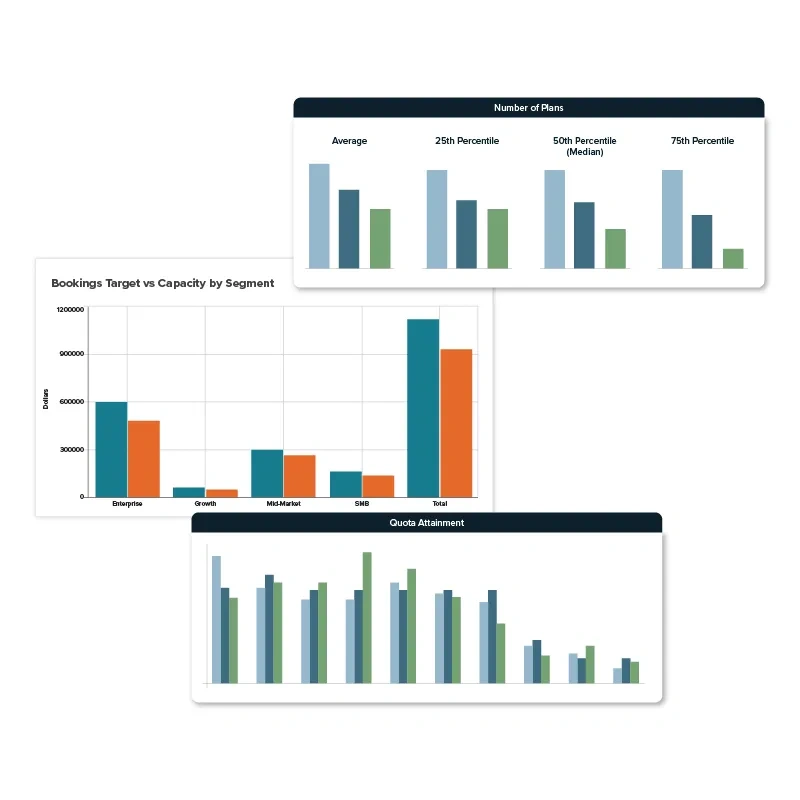
Xactly helps enterprise organizations connect performance visibility, incentive strategy, forecasting, and revenue planning into one unified model. Instead of making leaders gather insights from different systems, we help them see how revenue performance is shaped across the business.
With a more connected approach, organizations can:
- Improve visibility across teams, roles, and regions
- Align incentives more closely to strategic priorities
- Give managers better data for coaching and course correction
- Reduce administrative friction and manual reconciliation
- Support stronger revenue confidence as complexity grows
This is why Xactly is more than just a technology provider. We are a revenue performance partner built for complex organizations.
For leaders looking to deepen their thinking, resources such as The Revenue Leader’s Insight-Driven Guide and The Enterprise Guide to Sales Performance Management offer additional perspectives on how performance, incentives, and forecasting work together in a modern enterprise environment.
6 Best Practices for Building an Enterprise Sales Performance Management System
Enterprise leaders don’t need more theory. They need practical ways to build a system that keeps working as the business grows.
1. Start with a smaller set of high-value metrics
A scalable system is built on focus, not endless measurement. Identify the few metrics that best reflect business priorities, then align teams around them.
2. Connect performance measurement to incentive strategy
If performance measurement and compensation design are handled separately, it leads to mixed signals. Regularly check if your current structures encourage the right behaviors as priorities change.
3. Give managers earlier, more actionable signals
Managers can have a big impact on enterprise performance management, but only if they spot issues early enough to respond.
4. Reduce dependence on manual workarounds
Manual processes might seem quick, but they become a real problem as you scale. Replace them with systems that make performance data easier to trust and use.
5. Standardize definitions before complexity multiplies
Create shared definitions for the KPIs that matter most. Standardize review expectations across teams and regions.
6. Build for adaptation, not just control
Performance management shouldn’t be so rigid that it can’t adjust to market changes, new sales approaches, or shifting priorities.
Building a More Connected Performance Management Strategy for Enterprise Growth
Managing performance at scale isn’t about adding more dashboards, scorecards, or formal reviews.
It’s about creating a system leaders can trust.
This means having a system that shows the difference between effort and results, aligns incentives with strategy, and helps managers coach sooner, leaders decide faster, and organizations grow while keeping clear visibility into strong performance.
By unifying performance visibility, incentive alignment, and revenue decisions, Xactly helps enterprise leaders shift from disconnected measurement to more strategic performance management.
Build a performance management system that scales with your business.

See how Xactly helps enterprise leaders unify performance, incentives, and forecasting.