

The 10 highest-paying sales jobs
Sales is one of the few career paths where you can reach six figures without a graduate degree, a technical certification, or a decade of experience. What it does require is the right role, in the right industry, with the right skill set to match.
The range in sales compensation is dramatic. An entry-level retail sales associate and a senior sales manager are both “in sales” - but their earnings can differ by $100,000 or more annually. The difference comes down to what you’re selling, who you’re selling it to, and how much expertise it takes to close the deal.
This guide ranks the 10 highest-paying sales jobs using data from the U.S. Bureau of Labor Statistics, breaks down what each role actually involves, what drives pay above the median, and what it takes to break in. We’ve also included a bonus section on emerging high-earning roles - like enterprise software and medical device sales - that don’t yet appear in BLS categories but are among the most searched and highest-compensated in the market.
Whether you’re mapping your next career move or benchmarking what you should be paying, here’s where the real money is in sales - and what it takes to get there.
What Makes a Sales Job High-Paying?
Not all sales roles are created equal. Before diving into the list, it’s worth understanding the three factors that consistently drive compensation higher.
Deal Size and Complexity
The most direct driver of sales pay is the value of what you’re selling. A rep closing a $5 million enterprise software contract or a multi-year industrial equipment deal is going to command significantly higher compensation than one selling consumer subscriptions. Larger, more complex deals require more time, more skill, and more relationship-building - and the commission structures reflect that.
Technical Expertise
Roles that require genuine domain knowledge - engineering, finance, life sciences, cybersecurity - are harder to fill, which means they pay more. A sales engineer who can explain a product’s technical architecture to a client’s IT team, or a pharmaceutical rep who understands clinical trial data, brings a rare combination of expertise that commands a premium.
Market Type: B2B, B2G, and Enterprise
B2B sales jobs consistently outpay B2C roles because business buyers make larger, higher-stakes purchasing decisions with longer evaluation cycles. B2G (business-to-government) roles, particularly in defense and infrastructure, can be even more lucrative - though they come with long procurement timelines and significant regulatory complexity. The more consequential the purchase, the more the buyer values a skilled, knowledgeable rep.
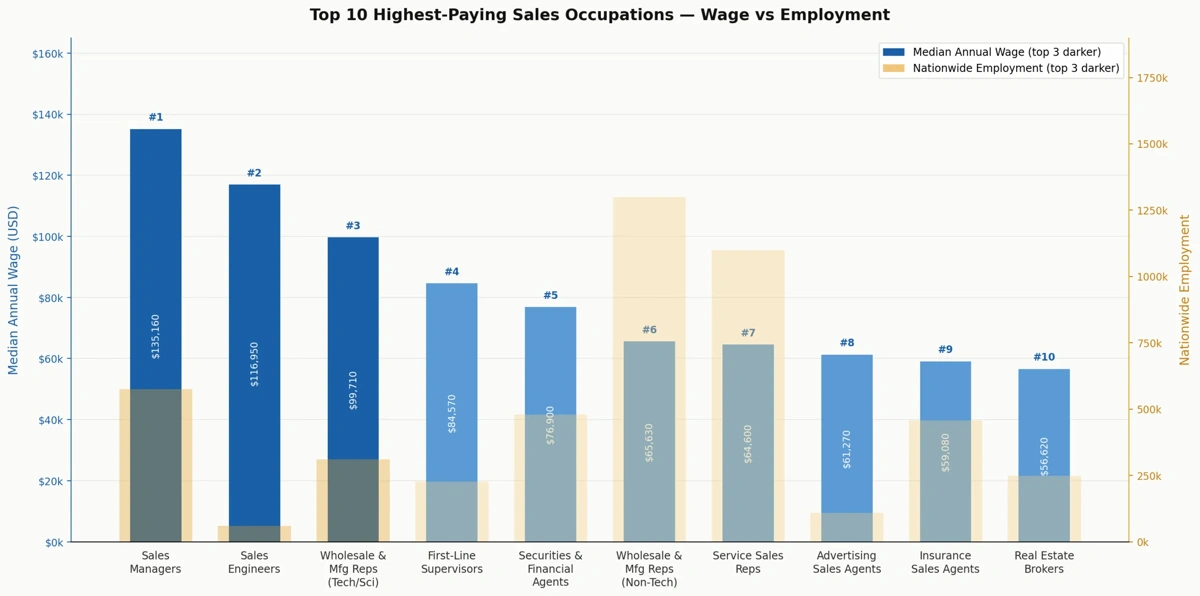
The 10 Highest-Paying Sales Jobs in 2026
All salary data sourced from the U.S. Bureau of Labor Statistics Occupational Employment and Wage Statistics.
#10. Real Estate Brokers and Sales Agents
Median annual wage: $56,620 | $27.22/hr | 249,080 jobs nationwide
Real estate agents and brokers facilitate property transactions - advising buyers and sellers on pricing, preparing contracts, marketing listings, and negotiating terms. Brokers hold additional licensure that allows them to operate independently or manage other agents.
What drives pay higher: The BLS median understates the upside in this field. Top producers in commercial real estate or luxury residential markets can earn well into six figures, with commission-only structures meaning there’s no real ceiling. Market conditions and network strength are the primary variables.
How to get in: Most states require a pre-licensing course and a state exam. No college degree is required, though brokers typically need additional education and experience beyond agent status.
#9. Insurance Sales Agents
Median annual wage: $59,080 | $28.40/hr | 457,510 jobs nationwide
Insurance agents match individuals and businesses with coverage - life, health, property, commercial liability, and more. The role is built on relationship development: agents grow their books of business through referrals, networking, and cold outreach, earning ongoing commissions from policies they place.
What drives pay higher: Agents who specialize in commercial lines or high-net-worth clients, or who build large recurring books, can substantially exceed the median. Residual commission structures mean strong early years compound into significant long-term income.
How to get in: State licensure is required; specific licenses vary by product line. A high school diploma meets the minimum bar, though employers increasingly favor bachelor’s degrees, particularly for larger agency or carrier roles.
#8. Advertising Sales Agents
Advertising sales agents sell ad inventory and campaign solutions to business clients - across digital, print, broadcast, and out-of-home media. It’s a B2B role that requires understanding both the client’s marketing goals and the platform’s audience data well enough to build a compelling case for investment.
What drives pay higher: Digital advertising specialists, particularly those with expertise in programmatic or performance marketing platforms, command the highest compensation as media budgets continue shifting toward measurable digital channels.
How to get in: Entry-level roles are accessible with a high school diploma, but a bachelor’s degree in marketing, communications, or business is preferred by most employers and is effectively required for senior or account director roles.
#7. Service Sales Representatives
Median annual wage: $64,600 | $31.06/hr | 1,100,000 jobs nationwide
Service sales reps sell intangible offerings - IT services, logistics solutions, consulting, telecommunications, and more. They handle inbound inquiries, prospect new accounts, demonstrate service value, and close contracts, typically working within CRM platforms to manage their pipelines.
What drives pay higher: Reps who specialize in complex, high-ACV (annual contract value) service categories - particularly managed IT services or enterprise logistics - earn significantly above the median. SaaS-adjacent service roles are among the fastest-growing and best-compensated in this category.
How to get in: A high school diploma is the minimum requirement. CRM proficiency and prior customer-facing experience are strong differentiators. This is also one of the most common entry points into B2B sales more broadly, making it a smart first step for those building toward higher-earning roles.
#6. Wholesale and Manufacturing Sales Reps (Non-Technical)
Median annual wage: $65,630 | $31.56/hr | 1,300,000 jobs nationwide
These reps sell manufactured or wholesale goods - industrial products, consumer goods, food service supplies, building materials - to retailers, distributors, and businesses. The role covers pricing negotiations, contract terms, delivery logistics, and ongoing account management after the sale.
What drives pay higher: Reps managing large national accounts or high-volume distribution relationships earn well above the median. Industry specialization - particularly in food service, construction, or industrial goods - and strong account relationships are the primary levers.
How to get in: Most employers require a bachelor’s degree or vocational training, plus working knowledge of the products being sold. This role is often the gateway into technical sales for those who later develop specialized domain expertise.
#5. Securities, Commodities, and Financial Services Sales Agents
Median annual wage: $76,900 | $36.97/hr | 479,630 jobs nationwide
Financial sales agents connect buyers and sellers of financial instruments - stocks, bonds, commodities, derivatives - or advise clients on financial products ranging from wealth management services to institutional investment strategies. The role sits at the intersection of market knowledge, relationship management, and sales execution.
What drives pay higher: The upside in this field is among the highest on the list. Top performers in wealth management, institutional trading, or investment banking sales regularly earn several multiples of the BLS median through bonuses, commissions tied to assets under management, and carried interest structures.
How to get in: A bachelor’s degree is required, and most client-facing roles require FINRA licensing (Series 7, Series 63, or others depending on the role). An MBA accelerates entry into senior positions and opens doors to the highest-earning segments of the field.
#4. First-Line Supervisors of Non-Retail Sales Workers
Median annual wage: $84,570 | $40.66/hr | 227,150 jobs nationwide
First-line sales supervisors manage the day-to-day activities of non-retail sales teams - setting performance goals, coaching reps, handling territory assignments, managing budgets, and reporting results to senior leadership. It’s the first true management role in the sales career ladder.
What drives pay higher: Supervisors managing larger teams, higher-revenue territories, or specialized B2B sales forces earn above the median. Performance bonuses tied to team quota attainment are standard in this role.
How to get in: Most employers require a high school diploma and several years of demonstrated success in a frontline sales role. Leadership and coaching ability are weighted more heavily than formal credentials at this level.
#3. Wholesale and Manufacturing Sales Reps (Technical and Scientific)
Technical sales reps sell complex products - industrial machinery, laboratory equipment, medical devices, engineering components, chemical compounds - to manufacturers, hospitals, research institutions, and government buyers. The role demands real technical fluency: buyers are often engineers, scientists, or clinical professionals who expect the rep to understand what they’re selling at a deep level.
What drives pay higher: Reps specializing in high-unit-cost categories like capital medical equipment, defense components, or precision manufacturing systems routinely earn well above the median. This role has one of the strongest salary trajectories in all of sales as technical expertise compounds over time.
How to get in: At minimum, two years of post-secondary education in a relevant technical field. A bachelor’s degree in engineering, chemistry, biology, or a related discipline is standard for most employers and effectively required for senior territory roles.
#2. Sales Engineers
Median annual wage: $116,950 | $56.23/hr | 59,340 jobs nationwide
Sales engineers are the bridge between a company’s technical team and its customers’ decision-makers. They conduct technical demonstrations, answer detailed product questions, develop customized solution proposals, and work alongside account executives to close complex deals - particularly in software, hardware, industrial systems, and advanced manufacturing.
What drives pay higher: The combination of engineering knowledge and sales skill is rare, which is precisely why this role commands a premium. Sales engineers at enterprise software and industrial technology companies, where deal sizes are large and technical evaluations are rigorous, consistently earn above the BLS median. Senior sales engineers at leading tech firms regularly exceed $200K in total compensation.
How to get in: A bachelor’s degree in engineering, computer science, or a related STEM field is the standard entry point. Strong interpersonal and communication skills are equally important - this is fundamentally a sales role that requires the ability to translate technical complexity into business value.
#1. Sales Managers
Median annual wage: $135,160 | $64.98/hr | 575,880 jobs nationwide
Sales managers own the full commercial operation of their teams: hiring and developing reps, setting and defending quota assignments, building forecasts, analyzing pipeline health, running competitive intelligence, and reporting to senior leadership. It’s a role that requires equal parts strategic thinking and people management.
What drives pay higher: Sales manager salary varies significantly by company size, industry, and scope of responsibility. At enterprise technology companies and high-growth B2B organizations, total compensation - base plus bonus - regularly exceeds $200K. According to Glassdoor data, enterprise sales managers average $212,000 in total pay including variable components.
How to get in: Most roles require a bachelor’s degree and a track record of quota attainment in a junior sales role. The path typically runs through individual contributor success, then first-line supervisor, then manager - with each step requiring demonstrated performance, not just tenure.
Bonus: Emerging High-Earning Sales Roles (Not Yet in BLS Rankings)
The BLS categories above reflect how the government classifies occupations - but the market has moved faster than the taxonomy. These four roles are among the most searched, fastest-growing, and best-compensated in sales today, even though they don’t yet appear as standalone BLS categories.
Enterprise SaaS / Software Account Executive Typical OTE: $200,000-$300,000+ | Top performers: $500,000+ Enterprise AEs sell complex software solutions - CRM, ERP, cybersecurity, data platforms - to large organizations through multi-stakeholder, multi-month sales cycles. This is consistently the highest-earning individual contributor role in sales. According to LinkedIn workforce data, enterprise software sales is one of the top ten fastest-growing and highest-compensated job categories in the U.S.
Pharmaceutical Sales Representative Typical total compensation: $130,000-$165,000 Pharma reps promote prescription medications and treatments to physicians, pharmacists, and hospital systems. The role requires deep product and clinical knowledge, strong relationship-building, and comfort navigating complex healthcare buying environments.
Medical Device Sales Representative Typical total compensation: $150,000-$180,000 Medical device reps sell capital equipment, surgical instruments, and diagnostic tools to hospital systems and surgical centers. The role often involves direct involvement in clinical settings - including operating rooms - and requires both technical knowledge and the ability to build trust with clinical staff.
Cybersecurity Sales Specialist Typical total compensation: $175,000-$250,000+ Cybersecurity is the fastest-growing segment in enterprise sales, driven by surging demand for threat detection, compliance tools, and network security solutions. Reps who understand both the technical threat landscape and the business case for security investment command a significant premium.
Key Skills That Separate High Earners in Sales
Across every role on this list, the gap between median pay and top-performer pay is significant. The reps who consistently land at the top of the earnings range share a common set of skills.
Communication and active listening. The best salespeople understand what the buyer actually needs before they start presenting solutions. Listening is the foundation - everything else builds from there.
Emotional intelligence. Reading the room, managing objections without defensiveness, and building genuine rapport are skills that no CRM can replicate. In complex, relationship-driven B2B sales, EQ is often more valuable than IQ.
Negotiation and objection handling. Top earners know when to push, when to hold, and how to find terms that work for both sides. Negotiation isn’t just about price - it’s about structuring deals that close and stick.
Technical aptitude. In B2B sales, product knowledge is table stakes. But increasingly, buyers expect reps to understand the broader technical and business context - how the solution integrates, what the implementation looks like, what the ROI model is. Technical fluency is no longer optional in most high-paying sales environments.
Pipeline discipline. High earners are ruthless about prioritizing the right opportunities. They manage their time and pipeline with precision, not optimism - qualifying out early and concentrating effort where it’s most likely to convert.
Network development. Referrals remain one of the most reliable sources of qualified leads at every level of sales. Building and maintaining a strong professional network - in your industry, with past customers, and with adjacent roles - compounds in value year over year.
How to Use This Data If You’re in HR or Sales Leadership
The BLS figures in this article represent the median - meaning half of the people in each role earn more. Actual market compensation varies considerably by industry, geography, company size, and on-target earnings (OTE) structure. A sales manager at a mid-market SaaS company in San Francisco earns a different number than one at a regional manufacturing distributor in the Midwest, even if both carry the same title.
That gap is exactly why sales compensation benchmarking matters. Using median BLS data alone to set pay ranges creates real risk: undercompensate and you lose top candidates to competitors who’ve done the analysis; overcompensate without the right structure and you drive the wrong behaviors.
Effective benchmarking goes deeper - segmenting by role, industry vertical, company size, tenure, and quota structure to build a picture of what the market is actually paying for the specific talent you’re competing for. Understanding current sales compensation trends - including how pay compression is reshaping OTE structures in 2026 - is equally important context for any compensation leader.
Xactly’s 2026 Sales Compensation Report draws on proprietary pay and performance data across thousands of companies to give HR and sales leaders a clearer, more actionable view of what competitive compensation looks like for the roles they’re building around.
Conclusion
Sales offers one of the clearest paths to significant income in the U.S. job market - but where you land on the earnings spectrum depends almost entirely on what you sell, who you sell it to, and what expertise you bring to the table.
For job seekers and career changers, this list is a map. Identify the role that aligns with your background and interests, understand the entry requirements, and chart the path forward - whether that’s building technical knowledge, pursuing the right certifications, or targeting industries where deal sizes and complexity reward skilled reps most.
For HR teams and sales leaders, the median figures here are a starting point, not a strategy. The difference between attracting top sales talent and losing them to a competitor often comes down to how precisely your compensation benchmarking reflects what the market is actually paying - not what BLS averages suggest.

Benchmark compensation against Xactly’s verified pay and performance data.
Ready to go deeper? Download the 2026 Sales Compensation Report - trends, benchmarks, and incentive design data to build plans that attract and retain top sales talent.