

If you’re a CFO, CRO, or RevOps leader, you already know this: quotas are not just performance targets. They’re your revenue plan, your forecast assumptions, your hiring model, and your board story all rolled into one.
But quota management in 2026 is a lot more complicated than “last year plus 10%.” Shifting buyer behavior, new AI-driven revenue signals, market volatility, tighter capacity, and more complex go‑to‑market motions are forcing leaders to rethink how they set, validate, and manage quotas across the organization.
Today’s enterprise quota planning needs to:
- Align to revenue and profitability goals, not just top-line aspiration
- Adjust quickly as markets and motions shift
- Motivate sellers without blowing up cost of sale
- Stand up to board-level scrutiny
- Strengthen forecasting, not introduce more noise
In this blog, we’ll walk through:
- The main quota models (historical, market-based, predictive)
- How quota fairness, territory potential, and elasticity affect outcomes
- How quota design shapes motivation, behavior, and pipeline quality
- The move toward dynamic, scenario-modeled sales quota planning
- How Xactly helps enterprises operationalize modern quota strategy with data, AI, and a unified platform
Let’s start with why quota management now requires more rigor, intelligence, and cross-functional alignment than ever.
Quota strategy shouldn’t rely on guesswork. Learn how enterprise leaders use Xactly to model fair, flexible quotas tied to capacity, opportunity, and revenue goals.
Explore our approach: Request Demo
Why Quota Management Has Transformed for Enterprise Leaders
For a long time, quota-setting was a mostly manual process: pull last year’s numbers, apply a growth target, spread it across regions and roles, and refine a bit in spreadsheets. That doesn’t work anymore.
Today’s revenue organizations are dealing with a different reality:
- Market unpredictability. Economic swings, uneven demand, and shifting competition mean a static annual quota number can be out of date within a quarter.
- AI-generated insights. You now have access to deal health scores, buyer intent signals, and predictive attainment models. If quotas don’t reflect those signals, they quickly feel disconnected from reality.
- Cross-functional accountability. Finance, Sales, and RevOps all own a piece of the plan. They need shared assumptions, consistent data, and a common language for how quotas are built.
- Rep expectations. Sellers expect transparency and quota fairness. If goals feel arbitrary or unattainable, they disengage—or leave.
- Board-level scrutiny. Boards want to know quotas are grounded in bottom‑up capacity, realistic pipeline coverage, and predictive insight, not “stretch” assumptions.
The shift is clear: leaders want fewer opinions and more methodology. Modern quota management has to be equitable, data-backed, and defensible.
Strategic Quota-Setting Models for 2026
There isn’t a single “right” way to set quotas anymore. Most enterprises blend three models: historical, market-based, and predictive. The mix you use determines how fair, accurate, and adaptable your quotas are.
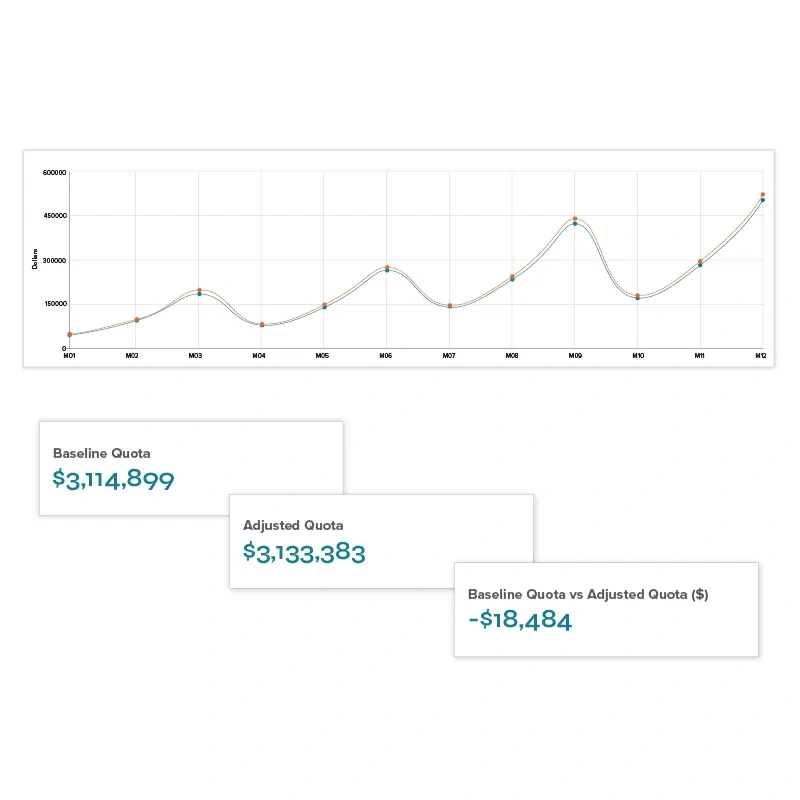
1. Historical Performance Quotas (Still Useful, But No Longer Sufficient)
Historically, many organizations leaned heavily on traditional top-down or historical quotas like:
- Prior-year attainment trends
- Average territory performance
- Seasonality patterns
- Rep/segment productivity
There’s still value here. Historical data gives you a baseline and helps you avoid setting numbers totally disconnected from reality.
But on its own, this approach has real drawbacks:
- It can lock in or reinforce inequitable territories and old patterns.
- It assumes the market will behave like it did last year, over-indexing on past markets.
- It ignores behavioral signals, like how deals actually move through the pipeline.
- It doesn’t reflect go-to-market changes like PLG, partner-led motions, or new inbound/outbound mixes.
In 2026, historical data is a good baseline starting point, but it’s not where quota strategy should end.
2. Market-Based Quotas for Strategic Fairness
More leaders are now grounding quotas in territory and market potential rather than just past results. This model looks at:
- Total addressable opportunity by territory or segment
- Territory quality and competitive saturation
- Industry-specific buying trends and budget cycles
- Economic conditions and expected spend behavior
- Product mix and margin variability implications
This approach is especially important for quota fairness. If one rep has a territory with 4x the potential of another, you can’t give them the same number and call it equitable.
When you build enterprise quota planning around opportunity and capacity, you get two big benefits:
- Better alignment between your quotas and your corporate targets
- Higher probability that reps actually believe the numbers and commit to them
3. Predictive Quota Models
Predictive forecasting approaches are where many organizations are heading next. Instead of just asking, “What did this team do last year?”, predictive quota setting asks, “What’s likely this year, given everything we know?”
Predictive quota models bring together:
- Historical attainment plus AI-modeled trends
- Behavioral buying signals and deal scores
- Reps’ past productivity arcs (how people perform over time)
- Pipeline coverage trends and win‑rate patterns
- Slippage or push probability
- Scenario simulations at team, region, and role level
The promise of predictive quota setting is simple: fewer surprises. You assign less phantom revenue, reduce over-assignment, and push forecast accuracy closer to where the board expects it to be.
The key executive question this helps answer is:
“How confident are we that these quotas support our revenue plan—without burning out our team or inflating cost of sale?”
The Strategic Levers Behind Effective Quota Design
No matter which model you use, a few levers determine whether quotas actually work in the real world.
Quota Fairness & Structural Equity
- Leaders must ensure quotas reflect:
- Territory potential
- Account mix
- Historical inequities
- Inbound/outbound weighting
- Competitive landscape
- Impact: Improves rep motivation, reduces churn, and minimizes shadow attrition.
Fairness isn’t just a feel-good concept; it directly affects performance and retention. Leaders must ensure that quotas reflect:
- Territory potential
- Account mix
- Historical inequities (who’s been over- or under-assigned)
- Inbound vs. outbound balance weighting
- Competitive landscape intensity
When reps see that quota coverage and potential are reasonably distributed, they’re more likely to trust leadership and stay. Employee churn is reduced and shadow attrition is minimized. This mirrors broader business research: if you don’t measure and correct structural imbalances, they persist.
Quota Elasticity & Market Adaptation
Quotas can’t be “set and forget” anymore. They need elasticity or adjustability. You must be able to adjust when:
- Demand cycles shift and swing sharply up or down
- Market downturns or expands
- New products change deal sizes or sales cycles
- Pricing or packaging strategy shifts and updates
- You add new incremental GTM motions (PLG, channel, etc.)
Static quotas in a dynamic market create misalignment and ugly forecast variance. Elastic quotas, backed by clear rules and data, help you adapt without losing credibility.
Quota Coverage Ratios
Quota coverage is one of the simplest and most powerful leading indicators you have. Executives should track:
- How much total quota is assigned relative to plan and what coverage is required to hit one’s plan
- What percentage of reps are sitting at 70–80% of quota mid‑year
- Where you’re over-assigning or under-assigning capacity in assignments to reps
- Whether capacity aligns with your revenue targets
Coverage is a leading indicator of organizational health. If coverage is way too high relative to realistic capacity, you’re banking on miracles. If it’s too low, you’re under-leveraging the team.
Quota Attainment Patterns
Think of quota attainment as more than just a final number; it’s a story told through data. To get the full picture, look for:
- The percentage of your team consistently hitting their OTE.
- Whether your revenue relies on a few "heroes" or is healthy across the board.
- How performance fluctuates between different seasons and market segments.
These quota attainment patterns tell you if you have a healthy distribution or a “hero culture” where only a few reps carry the number. They also tell you where to recalibrate for fairness and sustainability, especially in light of compensation trends like those covered in Xactly’s 2025 Sales Compensation Report.
How Quota Design Influences Motivation, Behavior & Forecasting
Quotas don’t just sit on a slide; they drive how people behave.
1. Rep Motivation & Retention
Unrealistic quotas do more than miss targets. They:
- Increase burnout and attrition, pushing sellers into “survival mode” instead of “growth mode”
- Erode trust between reps and leadership, which impacts team and company culture
- Reduce selling time
- Make recruiting harder when word gets out the numbers aren’t real
On the other hand, realistic, data-backed quotas anchored in capacity modeling and opportunity:
- Boost morale and focus
- Help reps’ productivity, spending more time selling instead of arguing about the plan
- Improve hiring and ramp success
2. Pipeline Behavior & Deal Quality
Quota design shapes how reps treat their sales pipeline. Poorly designed quotas can encourage:
- End-of-quarter over-discounting to close gaps
- Sandbagging to smooth performance over multiple periods
- Opportunity hoarding instead of healthy routing and collaboration
- Deal prioritization, where possible opportunities are neglected over others
When quotas and incentives are aligned, reps are more likely to build quality pipeline, prioritize the right deals, and follow a healthier rhythm.
Want a deeper view of how territories, quotas, and behaviors fit together?
Explore our guide: Mastering the Management of Territories and Quotas

Mastering the Management of Territories and Quotas
3. Forecasting Confidence
Ultimately, quotas impact and inform your forecast.
Good quotas improve:
- Forecast variance (how far off you are, quarter after quarter)
- Predictability and pacing
- Early risk detection
- Revenue pacing accuracy
If your board meetings are full of surprises, the problem may not be your forecast process. It may be your sales quota planning assumptions.
Common Quota Planning Gaps That Undermine Revenue Strategy
Even well-run enterprises fall into a few classic traps.
1. Overreliance on Top-Down Quotas
- This often leads to:
- Inflated expectations
- Poor rep adoption
- Missed forecasts
- Increased turnover
Top-down-only quota planning often leads to:
- Inflated expectations that reps discount from mentally
- Poor adoption of the plan in the field by your reps
- Missed forecasts that everyone saw coming
- Increased turnover among good sellers who just don’t buy the story
2. Territory Imbalances
Territory imbalances show up when:
- High or top performers are “protected” with the best books of business year after year
- New rep hires get low-opportunity territories and churn quickly
- Quota relief is inconsistent or opaque
The cost is more than missed numbers. It creates cultural friction that’s hard to recover from.
3. Lack of Scenario Modeling
Without robust scenario modeling or simulations, leaders can’t see:
- How new GTM motions will change capacity
- How pricing or discount changes will hit attainment
- How economic volatility might stress specific segments or regions
- How rep productivity assumptions hold up across different hiring plans
4. Spreadsheet-Driven Planning
Spreadsheets are great for quick analysis, but as a quota system, they eventually break. The common issues of spreadsheet-driven quota planning are:
- Manual errors and broken formulas
- Slow updates and limited what‑if analysis
- Version control headaches and misalignment
- Inconsistent formulas
And the real impact: leaders don’t fully trust the numbers, and it shows.
The Quota Management Maturity Model
Most organizations can see themselves in one of three stages.
Stage 1: Manual & Retrospective
In this stage, manual or spreadsheet-driven quota planning and overall quota volatility rules.
- Spreadsheets drive everything
- Little or no territory normalization
- Forecasts swing wildly and are variance heavy
- Reps don’t trust the process
Result: inconsistent performance and constant fire drills.
Stage 2: Structured & Data-Informed
In this stage, data begins to infiltrate the quota planning process to add some more sound objectivity.
- Shared definitions and a central data source
- Basic market and territory insights factored in
- Some normalization for fairness
- Centralized modeling for annual planning
Result: more predictable outcomes, fewer surprises.
Stage 3: Predictive & Scenario-Driven
By stage 3 of quota management, stronger predictions can be gained more consistently based on backed data and intelligence.
- AI‑enhanced quota modeling and capacity modeling
- Behavioral and intent signals blended with history
- Scenario simulations for multiple GTM and economic conditions
- Continuous optimization instead of annual “big bang” planning
Result: highly predictable, scalable revenue with a quota engine you can explain and defend.
How Xactly Strengthens Modern Quota Management
To move up that quota management maturity curve, you need more than a better spreadsheet. You need a connected system. That’s where Xactly and its different software come in.
- Xactly Plan
- Aligns capacity, quotas, and territories
- Models multiple quota strategy scenarios quickly
- Normalizes territories for quota fairness
- Connects quota logic to forecasting assumptions
- Xactly Design
- Creates compensation plans that reinforce quota behaviors
- Tests how quota changes affect payout structures
- Ensures incentives and quotas work together, not against each other
- Xactly Manage
- Centralizes compensation governance
- Ensures quota and payout rules remain consistent
- Reduces disputes and improves rep trust
- Xactly Forecasting
- Provides predictive attainment insights
- Surfaces slippage risks and deal health signals
- Improves cross-functional alignment on quota accuracy
The value of such a unified platform of software is simple: With all revenue planning, modeling, forecasting, and performance data in one ecosystem, Xactly delivers quota management that’s fair, data-backed, and inherently more predictable. It’s also a practical example of how using data systematically can create a real competitive edge.
Best Practices for Strategic Quota Management in 2026
Strategic quota management in 2026 involves intentional steps. To bring this down to a checklist, leading teams are:
- Standardizing quota-setting methodologies across teams and regions
- Normalizing territories and opportunity potential before assigning numbers
- Using predictive signals, not just historical data
- Building dynamic mid-year quota adjustment plans so quotas can flex with reality
- Reducing spreadsheet dependency and moving to connected systems
- Modeling multiple quota scenarios before rollout
- Aligning incentives with quota design from the start
- Tracking capacity and attainment continuously, not just at year-end
- Benchmarking both internally and externally against the broader market
- Making quotas more transparent and explainable to reps and leadership
FAQ Section
- What makes a quota “fair” in 2026?
A quota feels “fair” in 2026 when it’s grounded in real territory potential and market conditions, built from both data and field input, clearly explained, and genuinely attainable for a well‑performing rep—not just a heroic outlier.
- How does predictive modeling improve quota accuracy?
Predictive modeling improves quota accuracy by using real pipeline data, deal behavior, and historical trends to test scenarios and stress‑test assumptions, so you assign targets that reps can realistically hit while still supporting the board‑level revenue plan.
- Why should quotas incorporate market and territory potential?
Quotas should reflect the real size and quality of each territory, so reps with rich markets aren’t held to the same number as those in tougher ones. That keeps targets achievable, improves coverage, and makes “fairness” something you can actually defend to the field and the board.
- What is the link between quota design and forecasting variance?
Quota design is the starting point of the forecast. When quotas are unrealistic, misaligned to capacity, or uneven across territories, reps miss in unpredictable ways, and your forecast variance explodes. Well‑designed, data-driven quotas tighten attainment patterns and pull forecast error down into a manageable band.
- How does Xactly help organizations modernize quota management?
Xactly modernizes quota management by automating complex quota planning, using predictive and territory data to build fair, data‑driven quotas, supporting top‑down and bottom‑up scenarios, and tying quotas directly into forecasting, compensation, and CRM so plans stay aligned, auditable, and easy to adjust as markets change. Explore our products to get started.
Conclusion
Quota management in 2026 isn’t just about numbers; it’s about building a system that creates fairness, alignment, and predictable revenue.
Doing that strategic quota-setting well requires:
- A blend of historical, market-based, and predictive models
- Transparent logic tied to capacity and opportunity
- AI-powered visibility into risk, productivity, and attainment
- Incentive structures that reinforce the behaviors leaders want to scale and support your quota strategy
- A unified platform that connects planning, forecasting, and performance
With Xactly, leaders operationalize quota management as a strategic, data-driven discipline — giving CROs, CFOs, and RevOps teams the confidence to execute with clarity. So instead of an annual scramble, you have the confidence to walk into your next board meeting with a plan you can stand behind.
Discover how Xactly helps CROs and CFOs operationalize quota management with confidence.