
Introduction
Revenue risk analysis helps revenue leaders identify and quantify threats to predictable revenue, including deal slippage, pipeline inflation, stalled opportunities, and forecasting gaps. In today’s market, relying on CRM stages or rep sentiment alone is not enough. Buyer behavior shifts quickly, engagement patterns change, and hidden sales pipeline risk can build long before it appears in a forecast. AI-powered predictive pipeline visibility gives CROs and CFOs early warning signals, objective deal health scoring, and the clarity needed to prevent revenue surprises before they impact results.
That’s why the smartest revenue teams are focusing on more than just what the forecast says. They’re asking: Where’s the risk, and how early can we catch it?
This is where AI-powered revenue risk analysis comes in. Instead of relying on a rep’s “gut feel” or a green CRM stage, AI reads real-world activity data — like buyer response rates, meeting frequency, sentiment in emails, and deal velocity — to spot issues long before they become lost revenue.
It’s like having radar for your pipeline. You see what’s working, what’s stalling, and where trouble’s brewing — all in time to do something about it.
Let’s unpack what this looks like in practice (and how it helps you stay two steps ahead of revenue surprises).
What Is Revenue Risk Analysis? Why It Matters More Than Ever
Ask any sales leader what keeps them up at night, and most will say something like: I just don’t have line-of-sight into what’s real in the pipeline.
That’s a revenue risk problem.
Revenue risk analysis is about finding the cracks before they spread — the stalled deals no one’s noticed, the discount conversations that hint at trouble, or the “in-progress” deals that haven’t seen new activity in weeks.
The problem? Traditional sales pipeline forecasting has always relied heavily on rep judgment and CRM notes. But those tools miss the story happening between updates — the emails that go unanswered, the changes in tone on buyer calls, the shrinking of decision groups, the deals that slowly sit idle.
AI helps read these hidden signals at scale, spotting what humans can’t possibly track manually. Instead of waiting for quarter-end to realize a deal was never as strong as you thought, AI surfaces it weeks (or months) in advance.
And that’s not just nice to have. As CROs and CFOs work closer than ever, early visibility into risk is now a C-suite priority. You can’t align resources or defend numbers confidently with half the picture.
How Predictive Pipeline Visibility Works
Think of predictive pipeline visibility as switching from a rearview mirror to a forward-facing camera. Traditional forecasting tells you what just happened — AI shows you what’s about to happen.
Here’s how it works behind the scenes.
Signal Analysis Beyond CRM Fields
Your CRM is great for keeping tabs on deal stages and notes — but it’s a static picture. It doesn’t tell you momentum.
AI, on the other hand, looks at thousands of small behavioral clues that point to real-life progress (or risk). Things like:
- How often buyers are engaging (and whether the tone feels positive or cold).
- Whether meetings are happening consistently — or suddenly slowing down.
- If competitor names start popping up in call transcripts.
- Whether multiple stakeholders are still involved in emails or just one lone champion.
Add all that together, and you get a much clearer view of which deals are heating up and which ones are quietly cooling off.
Deal Health Scoring
You’ve probably seen “red/yellow/green” deal statuses in your CRM — but let’s be honest, those are usually based on rep opinion.
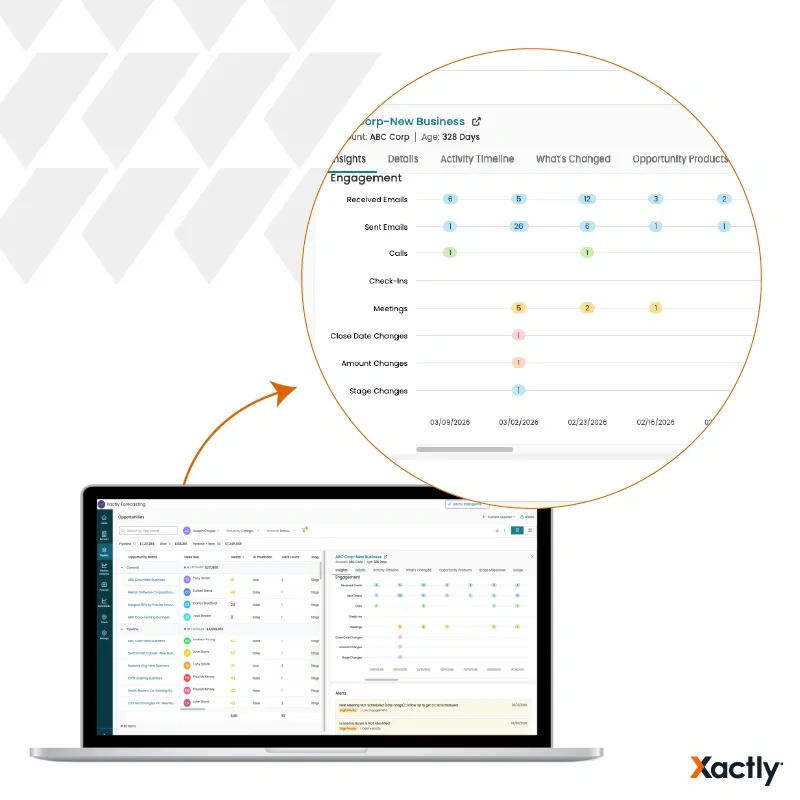
AI takes that same idea and makes it scientific. It scores deal health using a combination of engagement patterns, buyer activity, deal aging, and how similar deals have played out in the past.
So instead of a gut-feel “looking good,” you get something like: “Deal health score: 62 — engagement dropping, buyer response down 40%, sentiment neutral.”
Clear, factual, and actionable.
Predictive Patterns & Early Warning Indicators
This is where things really click.
AI doesn’t just flag what’s wrong — it spots patterns. It notices when deals tend to slip because decision-makers go quiet. Or when last-minute discount requests typically mean risk. Or when product mix changes hint that internal buyer priorities are shifting.
It’s the difference between reacting to bad news and adjusting course before things go sideways.
Why AI Reduces Revenue Surprises (Not Just Improves Forecasting)
Everyone loves a clean, confident forecast. But what most leaders really want is no more “I didn’t see that coming” moments.
AI forecasting gives you that — not just a more accurate number, but a clearer view into where that number could go off track.
Here’s what that looks like day to day:
Better Forecast Confidence
AI reduces dependency on rep sentiment. This means no more relying on how optimistic reps feel this week. AI looks at actual buyer activity — not opinions. For revenue leaders, that means going into forecast calls with data you can defend, and numbers you actually trust.
It helps CROs communicate more reliable numbers to Finance and the board. Finance gets transparency, Sales gets focus, and leadership stops playing “forecast bingo.”
Better Resource Allocation
AI revenue risk analysis helps identify which deals need executive intervention. When AI shows you which deals are healthy and which are falling apart, you can deploy help where it actually counts.
You can direct enablement, pre-sales, or discount approvals based on true deal risk. Execs can jump in on critical deals. Enablement can target stalled deals. Finance knows when to expect pushbacks. It’s a simple equation: less wasted time, more targeted effort, higher close rates.
Better Strategic Planning
AI reveals bigger trends. Understand which segments, products, or territories consistently underperform. Maybe your enterprise team crushes renewals but struggles in new logos. Maybe a specific product line consistently shows slowdowns late in the cycle.
Instead of guessing where to improve, you’ve got proof — straight from your own pipeline data, with pipeline inflation trends detected early.
Better Revenue Protection
AI helps prevent “end-of-quarter surprises” by identifying risk months earlier–think of it like your “anti-shock system.”
This is the biggest value add. Instead of learning about risk at the last minute, you see it building up weeks ahead. That gives you space to replan, reallocate, or step in early.
What CROs and CFOs Need From Revenue Risk Analysis
Let’s be honest: no one’s asking for another set of charts. What leaders want is clarity — to know what’s real, what’s at risk, and what’s next.
Here’s how AI delivers that clarity.
Pipeline Confidence at Every Stage
Instead of guessing which deals are shaky or fragile versus healthy, AI gives you visibility into health across each stage — from early interest to final negotiation. You see exactly where things are strong, where risk is accumulating, and where engagement is fading.
Signals That Predict Revenue Quality (Not Just Quantity)
Hitting your number doesn’t mean much if half of it’s bad revenue — low-margin, rushed, or unlikely to renew. AI helps leaders separate healthy deals from ones that add more risk than value. That’s how you protect long-term revenue quality.
Impact on Planning & Compensation Alignment
AI reveals whether incentives are driving the right deals or creating risk. The same visibility that improves forecasting can improve planning and comp. You can see whether your incentive plans are rewarding the right deal behaviors or driving short-term bloat that hurts later.
When compensation drives quality pipeline, not inflated pipeline, everyone wins.
Confidence in Resourcing & Headcount Decisions
With AI revenue risk analysis, workforce planning becomes data-driven, based on true pipeline health.
Real deal health data helps make workforce planning easier. You can shift resources to where pipeline risk is lowest — or see where more coverage is needed before you miss your targets.
Common Causes of Hidden Revenue Risk (And How AI Exposes Them)
Even experienced teams have blind spots. Here are some of the biggest — and how AI helps spot them before they cost you.
Stalled Deals Masked as “In Progress”
Detect stalled deals that look like they’re “Active”. A deal sitting in “Negotiation” for weeks might technically be open — but if there’s been no recent engagement, you’re staring at false hope.
AI immediately flags lack of engagement, changes in sentiment, and missing buying group activity based on inactivity or silence from key buyers.
Pipeline Inflation
We’ve all seen it — reps under comp pressure keep weak deals alive “just in case.” AI detects those patterns of rep-inflated pipeline (like multiple extensions or stalled stage movement) so you can focus on deals that are actually real.
Deal Slippage Misdiagnosed as “Bad Timing”
When deals slip, the knee-jerk explanation is “bad timing.” But AI often uncovers deeper structural issues or causes — a competitor got in late, a leader in your org pushed back on pricing, or internal stakeholders added blockers. Those details help fix the root problem, not just the symptom.
Unbalanced Pipeline Coverage
A healthy current quarter isn’t everything. If early-stage pipeline coverage is thin, you’re setting up for future misses. AI surfaces that early so leaders can guide teams to fill gaps before they become performance issues and deter from hitting long-term goals.
Territory or Segment-Level Weakness
Maybe one region’s pacing slower, or one segment’s conversion rates are dropping. AI benchmarks these patterns against historical performance so leaders can tell if the issue is isolated or systemic.
Why CRM & Spreadsheet Forecasting Fail at Revenue Risk Analysis
Spreadsheets and CRMs are great tools — but they’re not built for detecting revenue risk. They’re built for tracking what’s already happened.
Manual Data = Incomplete Data
Sales reps have a thousand things to do. Updating CRM fields consistently because CRM stages updated inconsistently isn’t always one of them. That’s how you end up with partial, outdated data.
Instead. AI cleans up that spotty data by pulling from what reps do, not just what they report and subjectively rely upon.
No Behavioral or Sentiment Insights
CRM data doesn’t capture buyer behavior signals. It tells you when a deal moved stages, but not why. It doesn’t “hear” buyer tone, read meeting notes, or detect confidence levels because it can’t spreadsheet systems can’t interpret transcripts, engagement, or patterns.
AI bridges that gap — reading into conversations to find the human signals of momentum or concern.
No Early Warning System
By the time traditional systems show you a problem or risk, you’re usually too late to fix it. AI catches those risk trends or slippage in revenue potential weeks earlier, giving you the chance to intervene before it’s a miss on the books.
No Cross-Functional Alignment
If Sales and Finance work from different forecasts, it creates disparity around revenue opportunities and risk detection. AI gives everyone — CRO, CFO, RevOps — a single, reliable view of the truth, where projected numbers are confidently in alignment. No surprises, no last-minute reconciliation fire drills.
How Xactly Supports Revenue Performance
Xactly’s unified platform helps companies connect every part of their revenue engine — planning, forecasting, incentives, and analysis — so leaders can act fast and decisively on risk.
- Xactly Plan: Align territories, quotas, and capacity with historical performance patterns — reducing structural revenue risk. Build smarter quotas and territory plans using historical performance, reducing structural risk before the year starts.
- Xactly Forecasting: Provides AI-driven signals and risk scoring. Delivers executive-ready pipeline visibility.Identifies early signs of deal slippage.
- Xactly Incent: Helps prevent “bad revenue” driven by misaligned incentives. Align incentives with deal quality instead of just volume.
- Xactly Intelligence + Benchmarking: Provides historical performance benchmarks. Revenue intelligence helps leaders understand risk in context of millions of data points.
- Wrap with value: Together, these modules unify planning, pipeline, incentives, and performance — giving leaders the clearest visibility possible into future revenue.
Together, these tools give you one connected source of truth — so every team, every forecast, and every plan moves in sync.
Best Practices for Revenue Risk Analysis
- Monitor pipeline velocity, not just size.
- Use AI-driven deal health, not rep gut checks.
- Review early-warning indicators weekly.
- Align incentives with good vs bad revenue behaviors.
- Benchmark against historical and cross-industry patterns.
- Combine forecasting + incentive + territory data for full revenue clarity.
- Replace spreadsheets with automated signal-based forecasting.
Conclusion: Xactly Brings Foresight, Not Just Analysis
In today’s market, you don’t just need to hit the number — you need to understand it. Today’s revenue engine requires more than forecasting — it requires risk detection.
AI-powered revenue visibility gives you that — a clear view into which deals are real, which are risky, and which need help. With that information, leaders can plan smarter, act faster, and make clear, aligned decisions grounded in truth.
Xactly brings planning, incentives, and forecasting together so teams can act on risk, not just observe it.
That’s not just better forecasting — it’s better foresight.