

Motivation, Performance & Profitability: How C-Suite Leaders Align Compensation with Strategic Revenue Goals
For years, enterprise leaders treated sales compensation as primarily a motivational mechanism: pay generously for raw performance, spotlight the top reps, and benchmark just enough to stay "competitive" in the talent market. That approach worked when growth was the only priority and margins were secondary.
In 2026, sales compensation has evolved into a precise lever that C-suite executives actively use to shape deal-level behaviors, protect profitability through product mix and pricing discipline, and ground forecast credibility in real capacity constraints rather than top-down aspiration. Poorly designed plans now create measurable P&L leakage through margin erosion, volatile quarter-end spikes, and overpayment for low-value revenue.
Modern revenue organizations are dealing with increasing pressures around:
- Margin compression and more complex pricing
- Expanding product portfolios where not every offer has the same profitability
- Longer sales cycles and deal-level risk
- Boards that now care deeply about the quality of revenue, not just the top line
That means your sales compensation strategies have to evolve beyond “pay for performance” and move toward “pay for the right performance.” Strategic plans turn compensation into predictable fuel for sustainable revenue quality.
In this blueprint, we will look at how executive teams can:
- Evaluate common sales compensation plan models through a profitability lens
- Understand the tradeoffs between aggressive incentives that can be revenue risk and revenue stability that provides growth acceleration
- Align incentives with product mix, deal quality, and long-term goals
- Operationalize compensation plan design and effectiveness using purpose-built Sales Performance Management tools

Why Sales Compensation Is a C-Suite Profitability Lever
Sales compensation is one of, if not the largest, cost line items for a sales organization. It also directly shapes what gets sold, at what price, and to which customers, so it has a clear impact on margin and revenue quality. Because of that, small plan changes can move millions in profit.
For senior leaders, that impact shows up in four areas:
- Product mix: Your sales compensation plan signals which products matter most and influences what sellers prioritize. If high-margin offerings are underrewarded, they are likely to get less attention.
- Pricing discipline: If plans reward revenue at any cost, sellers are more likely to discount to close gaps. That is how margin erosion sneaks in.
- Revenue predictability: Overly aggressive or misaligned incentives can create volatility and big swings in results, especially around quarter-end.
- Retention and trust: If the compensation plan design feels unfair, impossible, or incorrect, even strong sellers will start looking elsewhere. This erodes seller trust, reduces motivation, and increases attrition risk, affecting your GTM teams and causing you to miss revenue.
When sales compensation strategies are misaligned with your business strategy, you often see:
- “Bad revenue” that hits the number in the short-term but weakens margins or creates churn risk
- Forecast swings driven more by incentive deadlines than by customer demand
- Incentive costs that rise faster than revenue growth
At that point, sales compensation is not just a sales operations issue. It becomes a governance issue for the CFO, CRO, and the board. Research on incentive design in sales teams has highlighted how easily plans can create unintended behaviors if they are not tied to clear, strategic outcomes.
Defining Modern Sales Compensation Strategy
At the enterprise level, sales compensation strategies are more than commission rates. You are designing a coordinated system that connects overall organization and sales strategy to the efforts of those out on the front lines.
We have many tools at our disposal, like sales design and incentive compensation software:
- Modern leadership uses Xactly Design to model pay mix and leverage (base vs variable, role-specific upside), performance measures and weights (revenue, margin, product mix), quota and crediting rules tied to territory potential, payout curves with accelerators.
- Xactly Incent is then utilized for real-time governance, scenario testing, and rep dashboards that connect strategy to frontline execution.
When you treat sales compensation as a system, your main tools are the design levers inside that system, not just the plan labels. At a modern level, leadership is really working with:
- Pay mix and leverage: How much compensation comes from base pay versus incentives, and how much upside each role or segment has for strong performance.
- Performance measures and weights: Which metrics you pay on (revenue, margin, product mix, retention, multi‑year value, pipeline, etc.) and how heavily each one is weighted.
- Quota, targets, and crediting rules: How quotas are set, how deals are credited across roles and territories, and how closely those numbers track to true opportunity and capacity.
- Payout curves, thresholds, and accelerators: Where pay starts and ramps, where accelerators kick in, and how fast earnings grow so you can balance motivation with cost and stability.
- Timing, governance, and tooling: How often you pay and adjust, who approves changes, how you model scenarios, and how transparent the plan and earnings are for reps and managers.
Those are the core tools you use to connect high-level company and sales strategy to what actually happens in front of the customer.
The goal is not to maximize payout. The goal is to optimize behavior in service of your business’s strategic revenue goals.
A modern sales compensation plan should answer three simple questions:
- What behaviors do we need more of and less of?
- How do we encourage those behaviors in a way that still protects overall profitability?
- How do we keep the plan understandable and trusted in the field?
Starting with those three questions keeps you focused on what actually moves the business, not just what is easy to measure. They force you to connect incentives to margin and strategy, not just volume. And they keep complexity in check so reps understand, trust, and actually respond to the plan. Xactly’s 2025 Sales Compensation Report offers data on how leading organizations are evolving their sales compensation strategies to address these questions at scale:
Common Compensation Models & Strategic Tradeoffs
Most organizations mix several sales compensation plan models. Each model has strengths and tradeoffs. The label matters less than how the plan actually works under the hood. The key for executives is to understand what they are really buying when they choose one.
The mechanics inside each structure are where you either support profitability and stability or accidentally create risk.
Commission mechanics
At a basic level, commission pays a percentage of what a seller books. The levers that matter most are:
- The basis of credit: revenue, margin, ARR, multi-year value. If you pay only on topline revenue, you invite discounting and low-margin deals.
- The rate structure: flat rate versus tiered rates by product, segment, or margin band. Tiered and differentiated rates help you steer sellers toward strategic, higher-value offers.
- The guardrails: things like “no credit below X margin,” reduced credit on heavy discounts, or caps on low-value SKUs. Without these, commission-heavy plans can drive growth that looks good on paper but hurts profitability and forecast stability.
You can still run a commission-led design, but you de-risk it by tightening these mechanics around margin and product mix, not just volume.
Bonus mechanics
Bonuses are typically tied to a defined period and a broader set of goals. They are useful for managers, overlays, and teams that influence but do not directly own revenue. The key design choices are:
- The metrics and weights: which outcomes you reward (for example, retention, pipeline quality, cross-sell into target products) and how much each is worth. If you spread weight across too many metrics, you dilute focus and create confusion.
- The measurement rules: how results are calculated, validated, and adjusted. Vague definitions or frequent exceptions are what lead to disputes and erosion of trust.
- The timing and line of sight: how often bonuses are paid and how clearly people can see their progress. Long cycles with fuzzy tracking reduce motivational impact, even if the structure looks solid on paper.
Bonus-driven designs are powerful when you want to encourage long-term or team-based behaviors that do not show up as immediate bookings, but they only work if the metrics are few, clear, and measured in a way the field believes.
Quota-based and accelerator mechanics
Quota-based plans sit somewhere between pure commission and pure bonus. They often include accelerators as reps exceed target. The most important mechanics to get right are:
- Quota quality: whether targets reflect territory potential, capacity, and realistic productivity curves. If this is off, no amount of clever rates will fix the plan.
- Payout curves: how earnings ramp from 0 to 100 percent of quota and beyond. Steep curves near target can drive strong performance, but they can also create big cost spikes and end-of-period gaming if they are not modeled carefully.
- Thresholds and decelerators: where pay starts, and whether underperformance reduces upside. These choices affect both cost control and how mid performers feel about their path to meaningful earnings.
In practice, most “models” are some blend of these mechanics. The real strategic work for the C suite is deciding how each lever balances motivation, margin, deal quality, and revenue stability, then testing those choices with data before the plan goes live.
How Compensation Design Impacts Profitability
Compensation does not live in a vacuum. It shapes seller decisions in every deal conversation. Xactly Plan’s Territory and Quota Planning makes alignment real by matching quotas and capacity to true territory and account potential, so you are not paying rich incentives on structurally unbalanced books. It also lets you model and adjust quotas continuously, which keeps compensation, coverage, and forecast assumptions in sync as your market and strategy evolve.
Well-aligned sales compensation plans reinforce:
- The right products and bundles to prioritize for your growth plan
- Target deal sizes and customer profiles
- Sustainable pricing behavior that protects margin
Misaligned sales compensation plans often lead to:
- Over-selling low-margin or heavily-discounted products just to hit the number
- Short-term wins that increase support costs or churn down the road and undermine long-term value
- Revenue that is hard to forecast and harder to defend to the board
Executive teams must ensure incentives reward quality revenue, not just volume. Executives need to ask a simple question. “If a rational seller followed this sales compensation plan perfectly, would we get the business outcomes we actually want?” If the answer is no, the plan is encouraging the wrong performance. Pay should reflect economic value, not just volume. That is the heart of profitability-based compensation
Accelerators vs. Stability: Managing Growth Without Risk
Aggressive accelerators are often the go-to answer when leadership wants more growth. They work, but they need structure.
Key questions for the C-suite to consider would be:
- If 20 to 30 percent of reps hit the accelerator, what happens to our total payout and margin profile?
- At what attainment level do accelerators start to break our unit economics?
- How will this structure change end-of-quarter behavior, discounting, and forecast predictability?
Balanced sales compensation strategies:
- Reward outperformance without creating runaway cost when things go well
- Maintain seller motivation across economic cycles, in both strong and soft markets
- Support board-level confidence in revenue models because the cost per dollar of revenue is understood and controlled
At a greater scale, they also:
- Directly shape margin and deal quality, so they can add or erase millions in profit without changing headcount.
- Stabilize performance and forecasts, which reduces surprises in board meetings and investor updates.
- Influence who you keep and who you lose, because fair, well-designed plans protect top talent and culture instead of burning people out or pushing them to competitors.
Thoughtful incentive compensation management means you test these curves before rollout. You simulate a range of attainment outcomes and see what happens to cost, margin, and performance. That is how you drive growth without betting the P&L on an untested incentive.
The Compensation Maturity Curve
Not every organization is in the same place. It helps to think about sales compensation strategies on a maturity curve.
Stage 1: Tactical & Rep-Focused
Stage 1 of compensation alignment is not very aligned at all in terms of process and attention. There are:
- Spreadsheet-driven plans
- Limited modeling or scenario testing
- High incentive cost volatility creates surprises for Finance teams and leaders
Impact: The focus is on paying people correctly, but not on whether the sales compensation strategies support the business model.
Stage 2: Structured but Static
Stage 2 creates more structure to compensation planning yet doesn’t lessen the rigidity still existing. In this stage, there are:
- Defined compensation plan design processes and some governance
- Annual design cycles for plan updates
- More alignment across sales and finance, but limited adaptability to change
Impact: There is better control of comp planning here than Stage 1, but plans still lag behind market changes or new strategic priorities.
Stage 3: Strategic & Profit-Aligned
Lastly, orgs reach a place where planning and revenue are in one accord. There is:
- Scenario-based modeling before decisions are finalized
- Profitability and product-level incentives built into the sales compensation plan
- Continuous optimization tied to revenue intelligence and performance data
Impact: Sales compensation strategies operate as a true strategic lever. Leadership can adjust, test, and govern incentives with confidence.
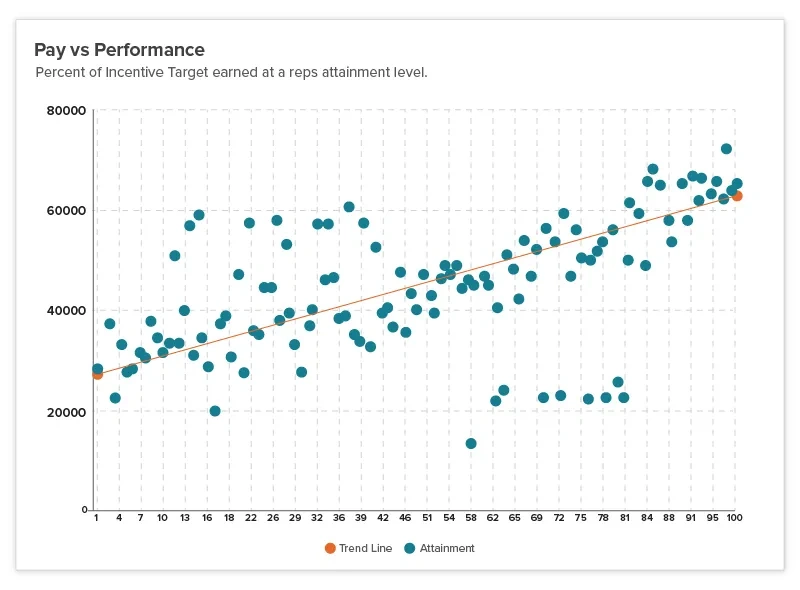
How Xactly Supports Strategic Compensation Design at Scale
To reach that strategic stage, you need more than a good idea. You need systems that can help you design, test, and run sales compensation strategies at enterprise scale.
Xactly’s Intelligent Revenue Platform supports the full lifecycle of incentive compensation management, enabling leaders to design, test, and govern compensation with confidence.
Xactly Design
- Models multiple sales compensation plan scenarios before rollout
- Evaluates payout impact across roles, regions, and products
Xactly Incent
- Automates accurate, transparent payouts that match your plan rules
- Reduces disputes and manual effort, which builds seller trust
Xactly Benchmarking
- Grounds sales compensation strategy decisions in real market data
- Validates plan competitiveness and sustainability
Xactly Plan
- Models different quota, territory, and pay mix scenarios against real capacity and targets, to actually deliver at scale
- Centralizes territory, quota, and plan mechanics in one place for more consistent, governed, adjustable compensation structures
This creates the value of a unified platform: Compensation, planning, and forecasting operate from a single, trusted revenue model, supporting profitable growth. That makes it much easier to align enterprise incentive strategy with your broader financial goals.
Best Practices for Aligning Compensation with Performance & Profitability
To pull all of this together, here are practical steps leadership teams are taking to modernize their sales compensation strategies:
1. Create a comp charter and stick to it
Define what you want incentives to buy (product mix, margin, segments, renewals, multi-year deals) and align CFO, CRO, CHRO, and RevOps on non-negotiables like incentive cost and minimum margin. Use this charter to vet every comp change.
2. Build on one unified revenue model
Design and test plans on the same capacity, quota, and pipeline assumptions used in planning and forecasting. Require impact analysis on payout, CCOS, margin, and forecast volatility, and retire ad hoc plans that are not tied to shared assumptions.
3. Optimize continuously, not once a year
Keep the core structure stable, but tune weights, thresholds, and accelerators quarterly or semiannually based on data. Use leading indicators to adjust early and run a standing comp council that approves small, frequent changes instead of emergency overhauls.
4. Pay for value with simple, segmented plans
Move from pure volume to value by adding profit metrics, differentiated rates by product or segment, and guardrails on low-margin deals. Use a small set of plan templates tailored to role and motion, each with two or three clear metrics reps can explain in under a minute.
5. Govern and automate for scale and transparency
Link comp to territory, quota, and pricing governance so changes are coordinated. Run calculations in a dedicated system integrated with CRM and HRIS, give reps and managers real-time dashboards, and use automation and benchmarks to free capacity for deeper modeling and continuous improvement.
The most effective plans are those that explicitly link pay to value creation and continuously refine the design based on data, not intuition.
Aligning Sales Compensation With Growth and Profitability
Sales compensation is no longer a tactical afterthought or decision. For the modern C-suite, it is one of the clearest levers you have to steer growth and profitability at the same time.
To align performance with profit, executives must adopt new sales compensation strategies that:
- Design incentives around clear business priorities
- Balance motivation with margin discipline
- Model compensation outcomes with clarifying modeling and benchmarking before plans go live
- Govern incentives with real data and integrated systems, not “gut feel” intuition
With Xactly, organizations move beyond reactive and spreadsheet-driven compensation planning toward a strategic, profit-aligned revenue engine. That gives leaders confidence not only that they will hit the number, but that the way they get there will stand up to margin, forecast, and board-level scrutiny.