
When sales, finance, and operations work in silos, targets start to feel arbitrary and forecasts lose credibility.
To combat this, organizations need an effective sales strategy and framework that:
- Brings sales, finance, and operations into one shared revenue model
- Grounds revenue planning in real capacity planning and productivity assumptions
- Connects territories, quotas, incentives, and sales forecasting into a single system
- Adapts as markets change, without reengineering spreadsheets every time
- Reduces forecast variance and supports decisions you can confidently defend at the board level
Let's take a closer look at sales strategy as a whole and explore how to make this happen.
Why Sales Strategy Is Important Now More Than Ever
Sales strategy is important more important now than before because sales planning has gradually shifted from "give the sales team a number” to “design the engine that runs our growth.”
It now sits at the intersection of financial discipline, sales operations, and sales execution.
A few forces driving this shift include:
- Revenue volatility: Economic uncertainty, longer sales cycles, and more deal slippage make the old style of static forecasting unreliable and have increased forecast risk.
- Complex go-to-market (GTM) models: Hybrid sales motions (enterprise, mid market, PLG, inside sales, and partner) all share the same P&L, but need different assumptions.
- Board-level scrutiny: Top-down optimism is no longer enough. Boards expect a bottom-up explanations and logic around revenue planning in regards to capacity, pipeline, and risk.
- Cross-functional dependency: Sales performance is tightly linked to finance assumptions, hiring/capacity plans, marketing pipeline, and incentive design.
Research on modern B2B growth models shows that companies that integrate sales strategy, analytics, and execution outperform peers over time.
Defining a Modern Sales Strategy
So what does “modern” actually look like in practice?
At the enterprise level, sales strategy means the coordinated design of:
- Revenue targets and growth assumptions
- Territory models and account coverage
- Quota setting and capacity planning
- Incentive and compensation structures
- Sales forecasting strategy and cadence
The goal is not to optimize any one element in isolation. The goal is to make sure the entire revenue engine behaves as one, aligned system.
When each piece is planned independently, you end up with misaligned quotas, unbalanced territories, and incentives that fight your strategy. That creates revenue volatility and constant firefighting. When the pieces work together, revenue becomes more predictable, even in a choppy market.
Analysts consistently frame sales strategy this way. It is no longer just about playbooks or messaging. It is about how all the levers connect to a clear, measurable plan.
The Core Pillars of a Revenue-Aligned Sales Strategy
A few core pillars can benefit executives when forming sales strategies and plans that have revenue in mind.
1. Revenue Targets Grounded in Capacity Reality
An effective sales strategy should start with a simple question: How much can this organization actually produce with the team or capacity and time we have?
Effective planning means you understand:
- How much pipeline and revenue your current salesforce can realistically deliver
- How many reps, by role and segment, you need to hit the plan and revenue goal
- How long deals take to move from qualified to closed in each motion
- Where productivity varies across roles, segments, and regions
Setting a top-down target without validating capacity can introduce immediate risk. It shows up later as missed numbers, burned-out teams, or emergency hiring.
This is where robust capacity planning is critical. You need a clear view of how rep headcount, ramp, and productivity curves translate into coverage against your revenue plan.
2. Territory & Coverage Design
Territory strategy is not just a sales operations concern. It directly affects:
- Quota fairness and trust in the plan
- Rep productivity and morale
- How pipeline is distributed
- The quality or accuracy of your sales forecasting
Building a modern sales strategy requires seeing and treating territories as part of the core sales, not a back-office exercise. The aim is to divide sales territories based on opportunity, not just historical rep performance.
If one territory has twice the potential of another, that should be reflected in both quota and coverage decisions.
3. Quota Strategy as an Instrument
Quotas should reflect:
- Market opportunity
- Territory potential
- Seller capacity
- Expected productivity curves
When quotas are disconnected from these inputs, they distort behavior and undermine trust.
Quotas sit at the center of your revenue model. They should help you consider:
- The true market and territory opportunity in each segment
- Realistic seller capacity and ramp time
- Expected productivity curves across different roles
- The enterprise sales strategy for growth, retention, and expansion
When quotas ignore these inputs, they distort behavior and undermine trust. Reps stop believing the numbers, and leaders stop believing the forecast.
Xactly’s sales and quota planning resources go deeper on how to design quotas that reinforce your strategy instead of undermining it.
4. Incentives That Reinforce Strategic Priorities
Compensation design must support — not contradict — sales strategy. Misaligned incentives can:
- Encourage discounting
- Over-prioritize short-term wins
- Undermine long-term growth initiatives
- Strategic planning connects quota logic directly to incentive outcomes.
You can have a great enterprise sales strategy on paper, but if your incentives point people in a different direction, execution will follow the money every time.
5. Forecasting Built on Planning Integrity
When quotas, territories, and incentives are misaligned, your sales forecasting becomes speculative rather than predictive.
Forecast accuracy starts long before the forecast call. It depends on planning quality. When your targets, territories, quotas, and incentives are misaligned, your sales forecasting strategy becomes more guesswork and speculative than predictive.
Conversely, when the planning inputs are structured and shared, sales forecasting becomes a way to monitor execution rather than a constant re-interpretation of the plan. For instance, Harvard Business Review points out that better structure and data use can improve forecast quality even when the future feels unclear.
Best Practices for Developing a Sales Strategy
Leading teams can follow the below best practices to turn sales strategy into an everyday management discipline.
They:
- Align sales, finance, and operations on shared assumptions and metrics
- Model multiple revenue scenarios before plan rollout and finalization
- Normalize territories and opportunity distribution to avoid built-in inequities
- Design incentives that reinforce strategic priorities and desired behaviors
- Continuously monitor capacity and productivity throughout the year, jot just at planning time
- Replace spreadsheets with integrated planning systems
The Sales Strategy Maturity Curve
Most enterprises can see themselves in one of three stages when it comes to sales strategy and execution. These include:
Stage 1: Fragmented & Spreadsheet-Driven
In the beginning phase, each function, department, or team manages its own spreadsheets. This means:
- Limited scenario visibility across teams
- Scenario testing is manual and slow or otherwise limited
- Forecast variance is high and surprises are common
Impact: Decisions are reactive, and results are inconsistent.
Stage 2: Structured but Static
In this stage, there are processes in place, but it isn’t nimble as needed for an ever-changing landscape.
- There is a defined planning process and calendar
- Data is more centralized and aligned and assumptions are shared
- Plans are more aligned but still hard to adjust mid-year
Impact: There is better control, but volatility increases when markets or strategy change quickly.
Stage 3: Integrated & Predictive
In this last stage, all systems and processes are nimble and in-sync for constant adjustment.
- Revenue data is unified across planning, execution, and sales forecasting
- Scenario-based planning is standard practice
- Your newly unified platform now supports continuous optimization instead of annual resets
Impact: Your organization achieves lower revenue volatility and sales strategy model that scales with growth.
How Xactly Enables Sales Strategy at Scale
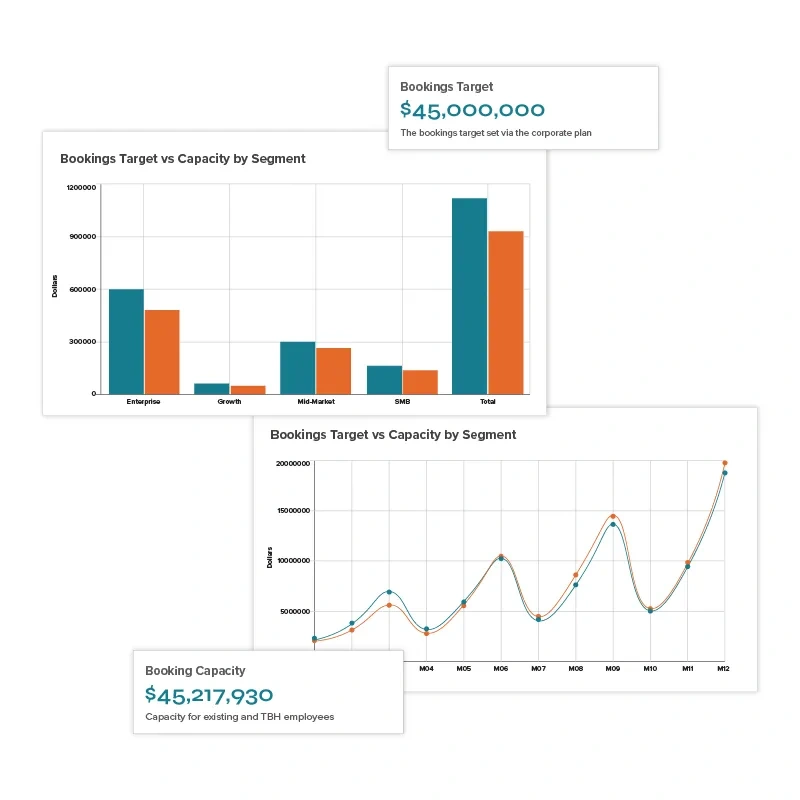
Xactly’s Intelligent Revenue Platform supports end-to-end sales planning and strategy development by unifying the systems and data executives rely on.
Here is how the core products fit into an enterprise revenue planning blueprint.
- Aligns territories, capacity, and quotas
- Enables sales scenario modeling across revenue plans
- Connects incentive strategy to planning decisions
- Tests how compensation outcomes change with quota adjustments
- Ensures governance and consistency across compensation execution
- Improves trust and transparency for sellers
- Improves forecast confidence with predictive insights
- Connects your sales forecasting strategy to planning assumptions directly to execution signals
The unified platform’s value becomes clear: Planning, execution, and forecasting operate from a single, trusted revenue model to create a coherent enterprise sales strategy that responds to change without losing control.
Build Your Sales Strategy with Xactly
Sales strategy is now a core executive discipline, not a functional task. And reducing revenue volatility requires:
- Integrated planning across sales, finance, and operations
- Quotas and incentives grounded in capacity and opportunity
- Forecasting built on data-validated assumptions
- A unified platform that connects planning to execution
- With Xactly, organizations move beyond fragmented planning toward a predictable, resilient revenue model that gives leaders the confidence to grow without volatility.
With Xactly, organizations move beyond fragmented planning and manual spreadsheets toward a predictable, resilient revenue model, which gives leaders something every executive wants more of in 2026: a strategy they can believe in and the confidence to grow.