

New chief revenue officers (CROs) and chief sales officers (CSOs) are expected to show results immediately. There is no adjustment period.
They inherit compensation structures, territories, and pipeline definitions they did not create, along with a board seeking assurance before the operating model might be fully understood.
A new leader can walk into what looks like a healthy revenue machine, only to discover:
- Forecast confidence is built on inconsistent inspection
- Quota attainment is masking capacity
- CRM stages are clean, but the underlying pipeline quality is not
- Finance, RevOps, and Sales are all using slightly different versions of reality
This 30-60-90-day playbook gives new CROs and CSOs a practical plan to review revenue performance, test old assumptions, align teams, and build a stronger base for steady, profitable growth.
Why the First 90 Days Define a Revenue Leader's Long-Term Success
For revenue leaders, early decisions compound quickly. Missteps in the first quarter often lead to incentive misalignment, forecast volatility, reactive quota and territory changes, and revenue “noise” that makes real performance issues harder to see. That is why the first 90 days carry disproportionate weight in any executive transition. As McKinsey notes, early leadership moves shape both credibility and long-term momentum.
The riskiest early mistakes are rarely dramatic. More often, they come from pattern-recognition failures. Leaders mistake noise for truth. They inherit legacy narratives and treat them as validated. They move quickly to take action, only to discover they changed a visible lever instead of the right one.
In practice, that often looks like quota changes that feel arbitrary, incentive updates that erode seller trust, or forecast calls that sound polished in meetings but collapse under actual conversion behavior. A disciplined leadership onboarding plan helps leaders move from assumption-based management to data-backed execution before those errors start compounding.
The Revenue Audit Framework: What New CROs and CSOs Should Assess First
Before changing plans, targets, or compensation, new leaders need visibility into how revenue actually behaves in the business today.
That means looking across five interconnected areas:
- Revenue data consistency across systems: Do CRM, forecasting, compensation, and finance data tell the same story, or are leaders making decisions across conflicting inputs?
- Quota and territory fairness: Are performance gaps truly talent gaps, or are they signs of uneven opportunity distribution, outdated account design, or unrealistic capacity assumptions?
- Compensation cost structure and incentive design: Are plans supporting the behaviors the business actually wants, or merely paying for activity that looks productive on paper?
- Forecast methodology and confidence levels: Is forecast accuracy grounded in stage progression and conversion evidence, or in rep sentiment and managerial optimism?
- Performance variability by segment, role, and product: Where is execution actually repeatable, and where is performance being propped up by a handful of outliers?
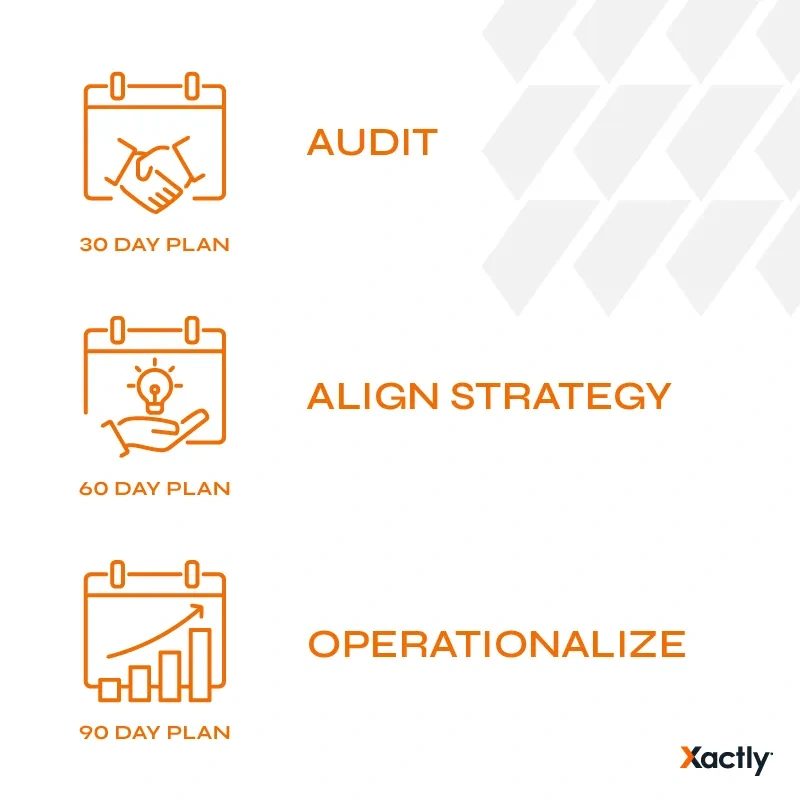
Days 1-30: How to Audit Revenue Data, Quotas, and Forecasting as a New CRO
Primary objective: Understand how revenue actually flows today.
The first month should not be spent launching a major redesign. It should be spent earning the right to redesign anything at all. That starts with a practical audit of revenue data sources across CRM, compensation, and forecasting; a review of current quotas, territories, and capacity assumptions; a closer look at compensation plans and payout logic; and an honest read on performance outliers, risk signals, and forecast accuracy versus actual outcomes. Those are the exact priorities the brief calls for, and they’re the right ones.
This is also the stage where cross-functional tension becomes useful. If Sales believes quotas are unrealistic, RevOps thinks pipeline hygiene is the problem, and Finance thinks the forecast is too elastic, that friction is diagnostic. It often reveals where core assumptions diverge.
These questions matter most in this window:
- Where is revenue predictable? And where is it fragile?
- Are sellers incentivized for the right behaviors?
- Which assumptions are driving forecast confidence or a lack of it?
Leaders who answer those questions early build a much stronger CRO onboarding plan than leaders who jump straight to corrective action.
This phase is really about connected visibility. New leaders need to understand how quota design, territory structure, incentive logic, payout accuracy, pipeline health, and forecast reliability interact before treating any one of them as a standalone issue. Compensation management discipline becomes easier to evaluate when leaders can see where plan design is shaping behavior instead of simply measuring payouts. Forecasting also needs to be assessed alongside planning and incentives, not as a separate workstream, because confidence in the number depends on far more than pipeline stages alone.
Days 31-60: Align Strategy, Incentives, and Execution
Primary objective: Correct misalignment without upsetting the field.
By the second month, leaders should have enough diagnostic clarity to distinguish isolated issues from systemic ones. This is where the work shifts from observation to alignment.
In enterprise revenue organizations, underperformance is rarely the result of one broken lever. More often, it’s the result of several tolerable misalignments that together create drag: quota models slightly inflated beyond capacity, territories shaped by history rather than opportunity, incentive plans that reward volume while ignoring margin or mix, or a forecast process that gives too much weight to rep sentiment and not enough to evidence.
At this stage, the core priorities are to:
- Validate quota fairness and achievability
- Review incentive structures for margin and behavior alignment
- Standardize forecasting methodology and cadence
- Tighten operating rhythms across departments
- Define leading and lagging indicators that can be used consistently
The challenge is not just spotting these issues. It’s correcting them without overcorrecting. Simpler doesn’t always mean better, and cleaner design doesn’t automatically lead to stronger execution.
How to Evaluate and Redesign Sales Quota Models in Your First 60 Days
Quota design is one of the highest-leverage decisions a new CRO or CSO will make, and one of the most commonly mishandled. The issue is usually not that quotas are simply too high or too low. It’s that leaders change them before understanding why the previous model produced the results it did.
A quota isn’t just a target. It’s a signal about what the business believes is achievable, and it shapes seller behavior, forecast confidence, and attrition risk accordingly.
Before adjusting quota models, evaluate:
- Attainment distribution, not averages. If 20% of sales reps are hitting 150% while 40% are below 60%, that points to coverage or design issues more than talent problems.
- Quota-to-capacity ratios. Pressure-test whether the aggregate quota is achievable based on headcount, average deal size, ramp time, and realistic sales cycles.
- Historical quota accuracy. Repeated over-setting erodes trust. Repeated under-setting creates a false sense of performance health.
- Territory opportunity parity. Two sales reps with identical quotas but very different addressable opportunities aren’t being measured on equal terms.
Good quota design is built bottom-up, not top-down. It starts with capacity, realistic productivity, and real win rates, then builds toward a target the business can actually deliver. It should also define clear performance bands: minimum acceptable performance, expected target attainment, and true over performance.
New leaders should resist the pressure to raise the bar in the first 90 days before validating that the current bar is being measured accurately and applied fairly.
Auditing and Aligning Sales Compensation Plans as a New CRO or CSO
Sales compensation is one of the most direct levers a revenue leader has to shape behavior, which is why it needs more discipline than urgency in the first 90 days.
A compensation plan can be technically functional and still strategically misaligned. It may pay correctly and still reward the wrong mix of behaviors for the company’s current stage, product mix, or market conditions.
Four questions matter most here:
- Are sellers paid for behaviors that create durable revenue? Plans that overweight new logo activity without considering deal quality, margin, or expansion potential may reward short-term wins that weaken long-term performance.
- Is OTE competitive and internally consistent? Incremental comp-plan changes over time often create inconsistencies across roles, segments, or geographies.
- How are accelerators and decelerators structured? Poorly designed tiers can inflate payout cost or hurt motivation without changing behavior meaningfully.
- Are SPIFs and overlays creating noise or signal? Too many incentive layers can obscure what the core plan is actually rewarding.
The governing principle is simple: don’t change compensation before you understand it. If changes are necessary in the first 90 days, leaders should communicate the logic clearly, phase changes where possible, and avoid retroactive adjustments tied to deals already in motion.
How New CROs and CSOs Can Build Effective Revenue Operations Alignment
RevOps misalignment is one of the most common and expensive sources of operational drag for new revenue leaders. The issue usually isn’t an open conflict. It’s divergence.
Sales, Finance, and RevOps often operate from slightly different versions of the same data, using definitions that have never been formally reconciled. Pipeline can mean one thing in CRM, another in the forecast call, and something else in the board deck.
This tends to show up in a few familiar ways:
- Forecast vs. finance reconciliation gaps: When the sales forecast and finance model consistently diverge, the issue is often definitional inconsistency, not just timing.
- CRM as source of record vs. source of truth: CRM reflects what was entered, not always what is true about deal quality or pipeline health.
- Sales-to-post-sale handoff friction: If “closed won” means one thing to Sales and another to Customer Success, retention and expansion risk begins immediately.
Effective RevOps alignment isn’t just a meeting cadence. It’s a shared operating model built on agreed definitions, shared data standards, and clear accountability. For new leaders, the practical starting point is a cross-functional data audit: get Sales, Finance, and RevOps aligned on what each team is measuring, where definitions differ, and which numbers the business actually trusts.
That conversation is often uncomfortable, but it’s usually clarifying. A documented set of shared definitions will reduce more friction than most process redesigns.
This is also the right stage for scenario testing. Revenue leaders should model plan and policy changes before rolling them out broadly, especially when those changes could affect seller behavior, forecast confidence, or cross-functional alignment. For leaders aiming to build a more insight-driven revenue strategy, this is where better decision-making starts to take shape. Forecast discipline should come from evidence, not optimism. Stronger forecasting depends on pressure-testing assumptions, improving inspection quality, and creating better visibility into what is actually likely to close.
Days 61-90: Operationalizing Forecasting, Performance Reviews, and Revenue Cadence
Primary objective: Move from assessment to confident execution.
By this stage, leaders should be converting insight into operating discipline. The priorities are to finalize refined quotas and incentive guardrails, operationalize forecasting and performance reviews, improve seller visibility into attainment and earnings, establish governance for ongoing plan adjustments, and create a repeatable revenue operating cadence. Those aren’t just cleanup tasks. They’re the mechanisms that keep the business from drifting back into legacy habits after a smart diagnostic phase.
By day 90, leaders should be able to show a clear revenue performance baseline, more trusted incentive and quota structures, improved forecast confidence, and stronger alignment across Sales, Finance, and RevOps. Communication matters as much as design work here. Sellers don’t need long explanations, but they do need clear logic. Finance doesn’t need optimism, but it does need confidence that revenue assumptions are becoming more rigorous.
The goal isn’t simply to improve the system. It’s to make those improvements repeatable.
5 Common Mistakes New CROs Make in Their First 90 Days (And How to Avoid Them)
The most common mistakes in revenue leadership onboarding stem from premature certainty. That usually shows up in one of five ways:
- Making quota changes before validating the underlying data: This creates noise fast. If the issue is coverage design, role capacity, or territory imbalance, a quota adjustment may only mask the actual problem.
- Overhauling compensation before understanding behavioral impact: Compensation plans aren’t just financial instruments. They’re behavior-shaping systems. Change them too early, and you can disrupt motivation, trust, or deal strategy without realizing it.
- Relying solely on CRM data for forecasting can create a false sense of precision. Forecast confidence needs to be pressure-tested against conversion behavior, inspection quality, and execution patterns, not just system updates.
- Treating incentives as tactical instead of strategic: Incentives influence what the field prioritizes, what gets discounted, what gets pushed, and what gets ignored. That isn’t tactical. That is revenue design.
- Under-communicating changes to the field: Even strong decisions can fail if the field experiences them as abrupt, opaque, or politically driven.
The best onboarding plans create enough space between diagnosis and redesign to ensure the business is solving the right problem, not the loudest one.
How Xactly Helps Revenue Leaders Operationalize with Unified Revenue Intelligence
The first 90 days put unusual pressure on revenue leaders because planning, incentives, forecasting, and execution are deeply connected. Yet many organizations still manage those areas through disconnected systems and manual workarounds.
Xactly’s Intelligent Revenue Platform supports revenue leaders by unifying planning across quotas, territories, and capacity; incentives and payouts; forecasting and pipeline intelligence; and benchmarking and scenario modeling. That allows CROs and CSOs to move faster, with more confidence, without relying on spreadsheets or disconnected systems.
For leaders trying to operationalize a revenue operations plan, that connected view matters. It reduces friction between functions, surfaces assumptions earlier, and helps teams make decisions with a shared operating model instead of fragmented reporting logic. For broader executive context, Xactly’s The Enterprise Leader’s Guide to Success in a New Revenue Era extends that perspective beyond the first-quarter transition window.
Best Practices for Successful Revenue Leadership Onboarding
The strongest revenue leaders focus less on appearing decisive and more on becoming directionally correct.
Diagnose before you redesign
Early pressure often pushes leaders to change visible levers like quotas, coverage, or compensation. But visible doesn’t always mean causal.
A better approach is to map what is actually creating friction:
- Where attainment differs sharply by segment or geography
- Where rep productivity diverges from capacity assumptions
- Where pipeline confidence is disconnected from actual conversion
- Where payouts are technically correct but behaviorally misaligned
Treat revenue quality as seriously as revenue growth
A revenue organization can hit the number and still weaken the business. That happens when compensation plans over-reward short-term volume, when discount-heavy deals distort productivity, or when expansion and retention quality are underweighted in performance logic.
Sophisticated leaders look beyond simply asking whether the team hit the target. They ask what kind of revenue was created, whether it was profitable, whether it was repeatable, and whether the plan design encouraged healthy behavior or forced behavior. That mindset leads to stronger decisions in both compensation design and forecasting.
Standardize forecasting early, but intelligently
A forecast process should reduce ambiguity, not hide it.
That means leaders need more than cadence. They need shared standards around stage definitions, confidence thresholds, risk flags, and what counts as meaningful evidence. Otherwise, forecast meetings become theater: polished narratives with inconsistent assumptions underneath.
A good forecasting discipline should make it easier to determine:
- Pipeline volume from pipeline integrity
- Manager confidence from evidentiary confidence
- Activity from deal progression
Use data to build credibility across teams
Strong onboarding requires leaders to clarify what Sales, RevOps, and Finance are actually measuring, where assumptions differ, and which numbers the business can truly trust. That alignment helps shift executive conversations away from competing narratives and toward a more shared operating truth.
Replace manual work with integrated systems where possible
Manual work isn’t just slow; it leaves room for different interpretations.
Every spreadsheet-based workaround introduces translation, versioning, and timing risk. That becomes especially dangerous during executive transitions, when leaders are trying to assess the business quickly and may not know where all the manual dependencies live.
Integrated systems do more than save time. They reduce decision friction. They make it easier to inspect the same logic across planning, incentives, and forecasting. And they help ensure that changes made in one part of the revenue engine aren’t invisible in another.
Moving from Revenue Leadership Onboarding to Revenue Impact
The first 90 days define a revenue leader’s trajectory. A successful onboarding plan helps CROs and CSOs build trust through data-driven decisions, reduce revenue volatility early, align incentives, quotas, and forecasting, and create a scalable foundation for growth. With Xactly, revenue leaders gain the visibility, structure, and intelligence needed to move from onboarding to impact, faster.
Build confidence in your first 90 days as a revenue leader.